
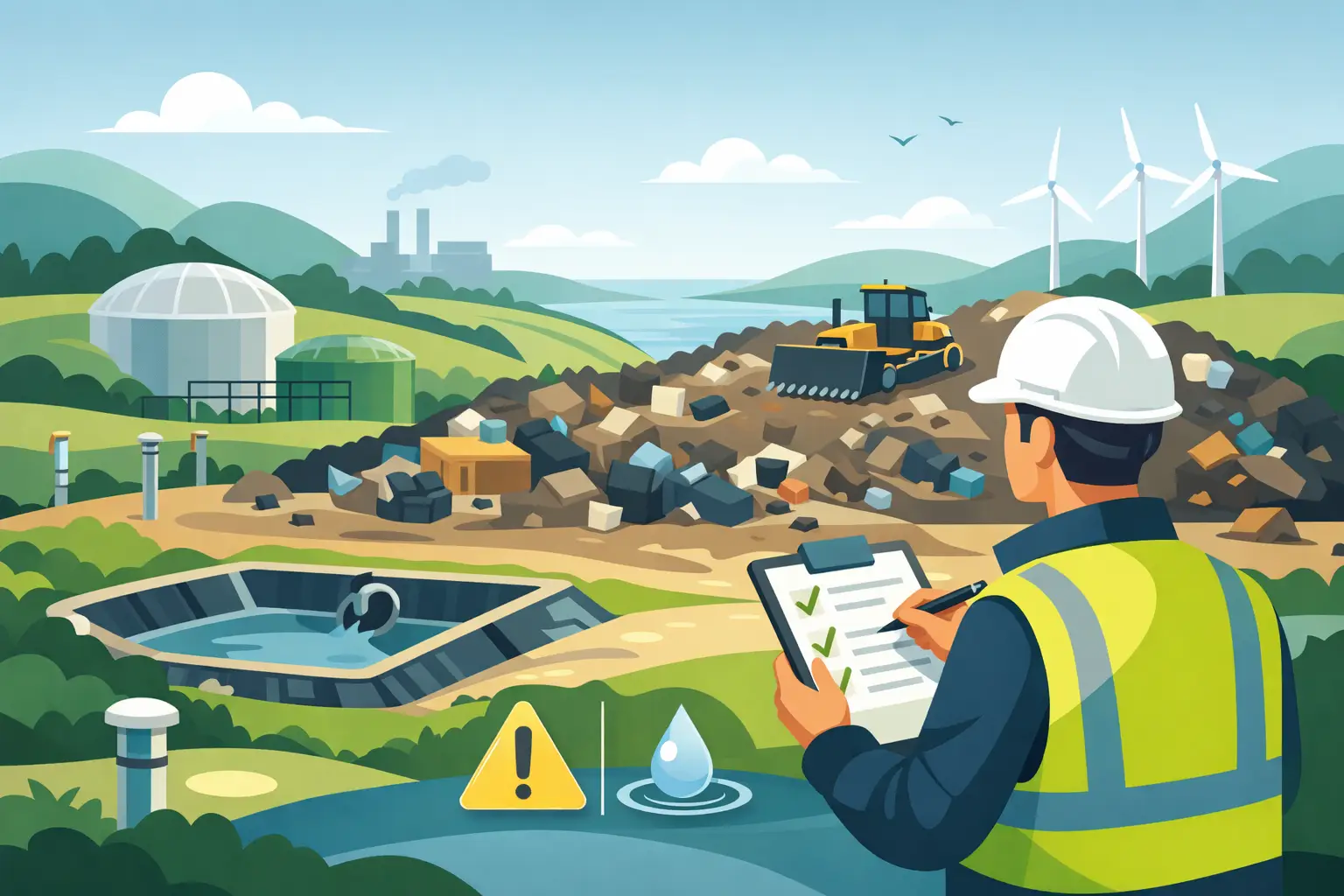
A landfill can appear to be operating normally while compliance risk is quietly increasing. A missed monitoring return, poorly controlled surface water, an unrecorded plant inspection or a change to waste acceptance practices can all create issues that are harder to resolve once identified by the regulator. Effective landfill compliance is therefore not a file of policies kept in an office. It is the day-to-day control of permitted activities, evidence and people across the site.
For UK landfill operators, the challenge is to maintain safe and commercially viable operations while meeting Environmental Permit conditions, approved management systems and wider legal duties. This requires a practical understanding of the permit, clear responsibilities and records that show controls are working in the field.
What landfill compliance means in practice
Landfill compliance starts with the Environmental Permit. The permit defines what the site may accept, how it must be operated, the emissions and environmental controls that apply, and the information that must be reported to the regulator. Its conditions should be treated as operational requirements, not simply as a document for senior management or audits.
The permit will sit alongside the site’s Environmental Management System, operational procedures, waste acceptance arrangements, monitoring plans, Fire Prevention Plan where applicable, and emergency procedures. These documents need to align. If the permit requires a particular control but the site procedure says something different, or staff cannot explain how the control is applied, the written system offers limited protection.
The level of control required depends on the landfill’s classification, the nature and volume of waste received, the surrounding environment, site infrastructure and the specific conditions attached to the permit. A site handling inert waste faces different risks from one managing biodegradable or hazardous waste. However, the central principle is consistent: operators must prevent pollution, minimise nuisance and demonstrate control.
The controls that regulators expect to see
A regulator’s inspection often begins with documents but quickly moves to what is happening on the ground. Site condition, staff knowledge and the quality of records must support one another.
Waste acceptance and load inspection
Waste acceptance is one of the most significant compliance controls at any landfill. Operators need a clear process for checking that waste is permitted, correctly classified and supported by appropriate documentation before unloading. Pre-acceptance checks, acceptance criteria, weighbridge records and load inspections should form a connected audit trail.
A load inspection should be meaningful rather than routine. Staff need to know what unacceptable waste looks like, when to quarantine or reject a load, who has authority to make that decision and how the incident is recorded. Repeated issues from a particular customer or waste stream should trigger a review of pre-acceptance information and supplier controls.
Where the waste is subject to testing requirements, sampling and analysis must be planned, undertaken at the required frequency and retained in a form that can be readily retrieved. Late testing, incomplete records or unexplained results can undermine confidence in the whole acceptance system.
Leachate, landfill gas and water management
Environmental risk does not stop at the tipping face. Leachate levels, landfill gas extraction, surface water drainage, groundwater protection and emissions monitoring require continual attention. The appropriate controls vary by site, but they must be based on the permit, approved plans and current operating conditions.
For example, heavy rainfall, a change in waste composition or a plant failure may alter the risk profile quickly. Site teams should have clear escalation routes for high leachate levels, damaged drainage, odour complaints, gas infrastructure issues or abnormal monitoring results. Waiting for the next scheduled review is rarely a suitable response to a developing problem.
Maintenance is equally important. Pumps, flares, monitoring equipment, drainage features and containment systems need planned inspection and servicing. A record that simply states “checked” is less useful than one confirming the inspection point, condition found, defect identified, action owner and completion date.
Site condition, nuisance and fire risk
Windblown litter, mud on roads, dust, odour, pests, noise and poor housekeeping can all lead to complaints and regulatory attention. These matters are often visible indicators of wider operational control. Daily inspections should identify issues early and assign corrective action before they become persistent.
Fire prevention deserves particular focus where combustible waste, stockpiles, plant and landfill gas are present. An approved Fire Prevention Plan must reflect the real site layout, waste types, storage arrangements, separation distances, fire-fighting provision and emergency access. It should be reviewed whenever operations change, not only after an incident or regulator request.
Building an evidence trail that stands up to scrutiny
Good records are not bureaucracy for its own sake. They show that the operator has identified risks, put proportionate controls in place and acted when those controls have failed or needed improvement.
Records commonly include waste transfer and acceptance documentation, daily site inspections, monitoring data, maintenance logs, training records, complaints, incidents, non-conformances, corrective actions and management review minutes. The most useful systems make it easy to connect these records. A complaint about odour, for instance, should be traceable through investigation, relevant weather or operational conditions, corrective action and follow-up.
Records also need to be complete, legible and retained for the required period. Backfilling inspection sheets shortly before an audit, using generic comments or leaving corrective actions open for months creates avoidable exposure. Digital systems can improve consistency and retrieval, but only if they match the site’s processes and staff use them properly. A simple, well-managed paper process is preferable to an unused digital platform.
Managing change before it creates a breach
Changes in landfill operations are a common source of non-compliance. They may include new waste streams, revised working areas, altered drainage, changes to operating hours, additional plant, revised waste volumes or new contractors. Some changes may require notification to the regulator, a formal permit variation or updated supporting documentation before implementation.
A structured management-of-change process helps operators ask the right questions early. Does the permit allow the activity? Does it affect emissions, capacity, storage, traffic movements or fire risk? Are revised risk assessments, procedures or training needed? Is regulator engagement required?
The answer will depend on the scale and nature of the change. Not every operational adjustment needs a permit variation, but assuming that a change is minor without a documented assessment is risky. Early review is generally faster and less costly than correcting an unauthorised activity later.
Competent people are a core compliance control
Landfill compliance depends on the decisions made by weighbridge staff, machine operators, site supervisors, environmental managers and contractors. A well-written procedure cannot compensate for employees who have not been trained, do not understand the permit or feel unable to challenge a questionable load.
Training should be role-specific. A weighbridge operative needs practical instruction on waste documentation and escalation. A mobile plant operator needs to understand working face controls, visual inspections and reporting requirements. Managers require sufficient knowledge to review performance, investigate incidents and make defensible decisions.
Competence also needs to be maintained. Refresher training, toolbox talks, incident learning and supervision are particularly valuable where there is staff turnover, changing waste streams or revised permit conditions. Training records should confirm not just attendance, but the subject covered, competence assessed where appropriate and any further support required.
A workable landfill compliance routine
The strongest sites turn permit requirements into a manageable operating rhythm. Daily checks deal with immediate conditions such as waste acceptance, litter, drainage, odour, plant defects and working face management. Weekly or monthly reviews consider trends, outstanding actions, monitoring results, contractor performance and recurring issues. Formal management reviews provide the opportunity to assess broader performance, resources, objectives and system improvements.
Internal audits are useful when they test reality rather than merely confirm that forms exist. A worthwhile audit will sample records, observe operations, speak to staff and test whether corrective actions have actually prevented recurrence. It should identify weaknesses early enough for management to act before they become enforcement matters.
External specialist support can be particularly valuable when a site is preparing for inspection, responding to a regulator concern, reviewing permit compliance, updating management documentation or considering operational change. EWS Consultancy Services works with operators to translate regulatory requirements into practical procedures, evidence and training that can be used at site level.
The most reliable approach is to make compliance visible in everyday decisions. When site teams understand the controls, records reflect real activity and managers address small deviations promptly, landfill operations are better placed to protect the environment, maintain regulatory confidence and keep the site operating as intended.