
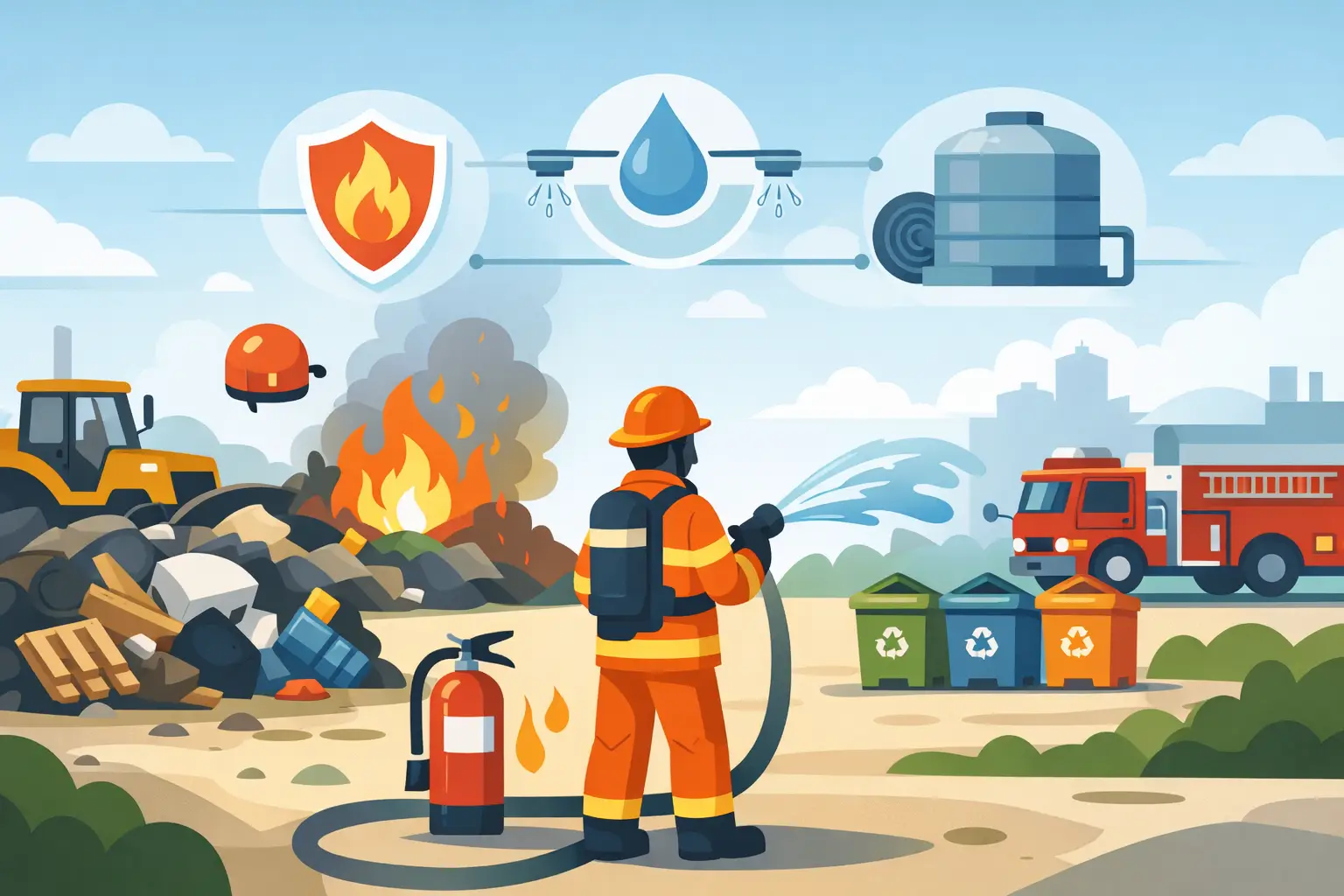
A fire on a waste site rarely starts as a single issue. More often, it is the result of small failures lining up – stockpiles left too large, materials stored too close together, temperature checks missed, ignition sources not properly controlled, or staff unsure what action to take when conditions change. That is why fire prevention plans matter. For operators working under environmental permits, they are not simply supporting documents. They are a practical framework for reducing fire risk, protecting neighbouring receptors and demonstrating to regulators that the site can be run safely.
What fire prevention plans are meant to achieve
In the waste sector, a fire prevention plan should show how a site will minimise the likelihood of fire, detect it quickly if one occurs, and limit the impact on people, the environment and the business itself. The Environment Agency expects these plans to be site specific. Generic wording and copied layouts rarely stand up to scrutiny because the real test is whether the controls reflect actual activities, storage methods, throughput, plant movements and emergency arrangements on the ground.
That matters for more than permit compliance. A weak plan can create operational problems long before a regulator comments on it. If storage limits are unrealistic, access routes are impractical or quarantine arrangements do not match available space, the document will fail under day-to-day pressure. A workable plan has to align with how the site genuinely operates.
Why fire prevention plans are under close scrutiny
Waste fires place pressure on fire and rescue services, disrupt local communities and can lead to serious pollution incidents. Smoke, contaminated run-off and damaged infrastructure can quickly turn a site fire into a much wider environmental event. Regulators therefore look closely at whether operators understand their risks and have credible controls in place.
For many permitted facilities, fire prevention plans are either a formal requirement or a key part of the wider compliance picture. Their quality can affect permit applications, permit variations and ongoing regulatory confidence. Where plans are vague, inconsistent with site layout or unsupported by operational evidence, that raises obvious concerns. Regulators want to see that the operator has moved beyond broad intentions and set out clear, achievable measures.
There is also a commercial reality. Fires interrupt contracts, damage equipment, affect insurance relationships and can stop a site trading for extended periods. Even where the physical damage is contained, the knock-on effects can be significant. For most operators, prevention is far less costly than recovery.
The difference between a compliant plan and a usable one
A compliant document should satisfy regulatory expectations, but that alone is not enough. The stronger standard is whether the plan can be used by site management and operational teams in real conditions. That means it should be clear on stockpile dimensions, separation distances, maximum storage durations, inspection routines, plant availability, water supply, site access and emergency escalation.
It should also reflect the specific waste streams handled on site. Different materials behave differently. Combustible mixed wastes, wood, paper, RDF and metal fines do not present identical hazards, and treatment activities can introduce further heat and ignition risks. The plan needs to show that these differences have been considered rather than grouped together under a single broad control measure.
This is where many documents become weak. They may describe ideal arrangements, but not the practical limits of the site. If a plan relies on space that does not exist, equipment that is not consistently available, or staff interventions that are unrealistic during busy periods, it is unlikely to hold up when tested.
Core areas every fire prevention plan should cover
The strongest fire prevention plans usually begin with a realistic understanding of the site itself. Layout is central. Stockpile locations, building uses, vehicle routes, drainage arrangements, neighbouring receptors and emergency access all affect how a fire might start, spread and be managed.
Storage controls are equally important. Regulators will expect clear information on pile sizes, heights, volumes, separation distances and how long waste is held before movement or treatment. These controls need to be tied to actual throughput and site capacity. If incoming volumes regularly exceed the assumptions used in the plan, the document is already out of date.
Monitoring and detection also need substance. That can include routine visual inspections, temperature checks where appropriate, supervision of high-risk materials, and clear triggers for intervention. It is not enough to say that staff will monitor waste. The plan should explain who does what, how often, and what happens when signs of heating, smoke or odour are identified.
Ignition source control is another area where detail matters. Plant and machinery, batteries, hot works, arson risk, electrical faults and smoking controls all need to be considered in a way that reflects site operations. On some sites, battery contamination in incoming loads may be a key concern. On others, mobile plant management or external trespass may be more significant. The right balance depends on the activity.
Finally, the response arrangements must be credible. Quarantine areas, fire water availability, access for fire and rescue services, use of on-site plant to separate burning material, drainage protection and communication protocols should all be set out clearly. If the response depends on resources shared across multiple sites or on contractors who are not always immediately available, that should be thought through carefully.
Common weaknesses in fire prevention plans
One of the most frequent problems is treating the plan as a one-off permitting exercise rather than a live management document. Sites evolve. Throughput changes, new wastes are accepted, buildings are repurposed and staffing structures shift. If the document is not reviewed against operational change, gaps appear quickly.
Another common issue is inconsistency between drawings, text and reality. A plan may show compliant stockpile spacing on paper, while the working yard tells a different story. Regulators and fire services will notice that disconnect. So will insurers.
There is also a tendency to overstate control measures. Operators sometimes feel pressure to present the strongest possible arrangements, but a plan that promises more than the site can sustain creates its own compliance risk. It is better to define controls that are practical, measurable and consistently deliverable.
Training is often underdeveloped as well. Staff do not need to memorise a full technical document, but they do need to understand the operational controls that sit behind it. If front-line teams are not clear on stock limits, inspection triggers, reporting lines or emergency actions, the plan remains theoretical.
How to make fire prevention plans work on site
The most effective approach is to develop the plan around actual site conditions and management behaviour, not around standard wording. Start with a realistic review of waste types, storage patterns, throughput, plant availability and spatial constraints. That creates a baseline for controls that can genuinely be maintained.
From there, the plan should be tested against normal and pressured operating conditions. It is easy to define safe storage limits during steady periods. The harder question is what happens when inbound volumes spike, plant goes off hire, a loading area becomes unavailable or a quarantine bay is already in use. A good plan recognises those pressure points and sets out how they will be managed before they become failures.
Drawings and supporting information should be precise and current. Site layout plans need to match the operation as it stands, including access points, drainage features, storage areas and fire breaks. Where site constraints prevent ideal arrangements, the plan should explain the compensating measures rather than ignoring the issue.
Operational ownership matters as much as document quality. Site managers, compliance leads and operational teams need to understand not only what the plan says, but why those controls exist. That understanding improves day-to-day decision making, especially when conditions shift quickly.
For operators seeking external support, the value is usually greatest where consultancy input is grounded in both permit expectations and site reality. EWS Consultancy Services Ltd works in that space, helping operators produce documentation that is technically sound, regulator-ready and practical enough to implement.
Fire prevention plans as part of wider compliance
A fire prevention plan should not sit in isolation. It connects directly to environmental management systems, site inspections, maintenance procedures, waste acceptance controls, staff training and emergency planning. Where those systems align, compliance becomes easier to sustain. Where they conflict, even a well-written plan can become difficult to apply.
That is particularly relevant for businesses managing multiple permit conditions or preparing permit applications and variations. Fire risk controls often expose wider operational questions about storage capacity, layout, drainage, supervision and record keeping. Addressing those points properly can strengthen the overall compliance position, not just one part of it.
There is rarely a one-size-fits-all answer. A small transfer station, a large recycling facility and a landfill-related operation will face different constraints and regulator expectations. The key is not to chase a generic model, but to build a plan that reflects the hazards, footprint and operating pressures of the specific site.
A well-prepared fire prevention plan does more than satisfy a requirement. It gives the operator a clearer grip on risk at the point where compliance, safety and business continuity meet. When that document is realistic, current and embedded into site operations, it becomes far more than paperwork.