
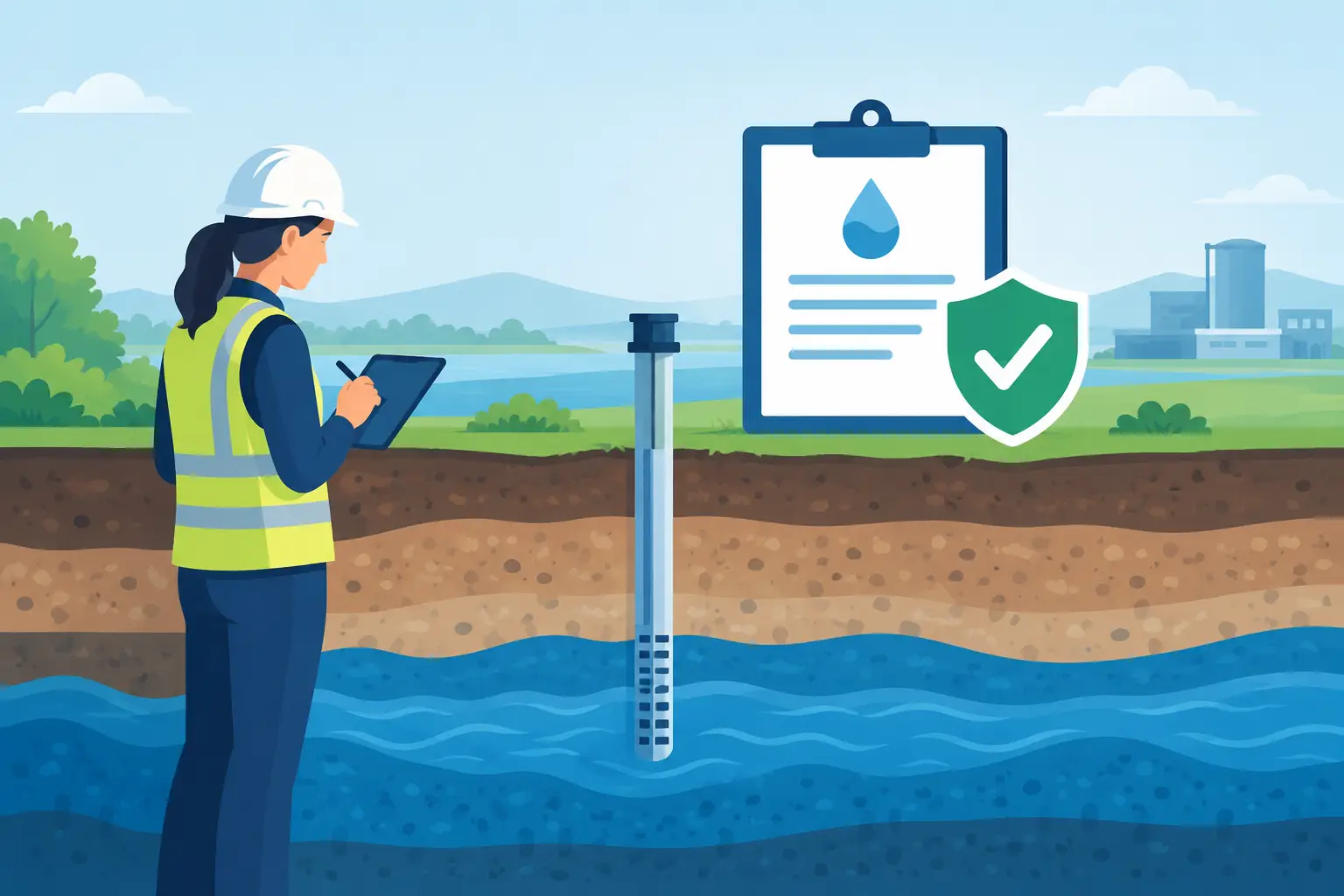
A groundwater risk assessment permit application can determine whether a proposed waste or industrial activity is acceptable at a site, requires further controls, or cannot proceed as designed. The assessment must do more than identify nearby water features. It needs to show, using proportionate site evidence, whether pollutants could reach groundwater and whether the proposed design and operating controls will prevent unacceptable impact.
For operators, the practical issue is clear: groundwater risks must be understood before a Bespoke Environmental Permit application is submitted, not explained away after the regulator has raised questions. A well-founded assessment reduces avoidable delays and gives site teams a clear basis for managing drainage, storage, containment, monitoring and incident response.
What a groundwater risk assessment permit review must establish
In UK environmental permitting, a groundwater risk assessment is usually required where an activity could result in a discharge to groundwater, an indirect input of pollutants through land, or a credible risk of contamination reaching an aquifer. It is commonly relevant to landfill and waste operations, land remediation, soil treatment, industrial facilities, liquid storage, treatment plants and some discharges to ground.
The terminology can cause confusion. A groundwater risk assessment permit is not generally a separate class of permit. It describes the technical assessment that supports the relevant environmental permit application and demonstrates compliance with groundwater protection requirements. The level of detail depends on the activity, the sensitivity of the site and the pollutants involved.
The regulator will want a defensible answer to three connected questions: what could be released, how could it travel, and what groundwater receptor could be affected? This is the source-pathway-receptor model. It is simple in principle, but the evidence supporting each part must reflect the conditions at the particular site.
A credible assessment should also distinguish between normal operation, foreseeable abnormal operation and accident scenarios. A sealed process area may present limited risk during routine use, but the position can change if a bund fails, contaminated surface water escapes to unmade ground, or a firewater incident overwhelms the drainage system.
Start with the proposed activity, not a generic report
The most useful assessments begin with an accurate operational description. This includes the materials received, stored, treated or produced; expected quantities; storage arrangements; drainage layout; treatment processes; vehicle movements; and potential contaminants. Describing waste only by its broad category is rarely enough. The physical form, handling method and leachability of a material can materially alter the risk.
For example, a risk profile for inert material stored on hardstanding will differ from that for fine waste, contaminated soils, liquid waste, hazardous substances or materials capable of generating contaminated runoff. Similarly, a proposed land remediation scheme must consider the contaminants already present in the ground as well as any introduced materials or reagents.
The assessment should identify realistic failure modes. These may include damaged containers, leaks from tanks and pipework, poor segregation, overfilling, blocked drains, defects in hardstanding, contaminated firewater and loss of containment during loading. The purpose is not to create an excessive list of unlikely events. It is to show that controls are designed around the risks that site operations can genuinely create.
Build a clear conceptual site model
A conceptual site model brings the available information into a form that can be tested and refined. It should set out the site setting, geology, hydrogeology, surface water features and potential receptors, before linking these to the proposed activity.
The desk study normally considers geological mapping, borehole records, hydrogeological information, groundwater vulnerability, Source Protection Zones, abstraction records where relevant, historical mapping, environmental data and previous investigation reports. Historic land use matters. Former landfill, quarrying, industrial use, made ground and known contamination can all influence pathways and baseline groundwater quality.
Site investigation may be necessary where desk-based evidence cannot reliably establish ground conditions, depth to groundwater, flow direction, permeability or the presence of contaminant pathways. However, investigation should be proportionate. A low-risk activity on fully contained hardstanding may not require the same level of intrusive work as a landfill, remediation project or development involving extensive ground disturbance.
The conceptual site model should account for vertical as well as horizontal pathways. A shallow perched water body, permeable made ground, fractured bedrock, service trenches, soakaways, drainage outfalls and boreholes can all provide routes that are not obvious from surface observations alone. Conversely, low-permeability strata and properly designed containment may materially reduce the likelihood of a release reaching groundwater. The assessment needs evidence for either conclusion.
Receptors and sensitivity
Groundwater itself is a protected receptor, but the assessment should also consider how it is used or connected to other environmental features. Private water supplies, licensed abstractions, springs, wetlands, watercourses with groundwater influence and protected habitats may increase the significance of a potential impact.
Sensitivity is not determined by a single map layer. An aquifer designation is relevant, but so are local geological conditions, the presence of nearby abstractions and the likely travel time from the source to a receptor. A site outside a Source Protection Zone may still require careful assessment if the proposed activity could introduce pollutants to permeable ground.
Demonstrating prevention and control
Where hazardous substances are involved, the expectation is prevention of entry to groundwater. For non-hazardous pollutants, the assessment must demonstrate that inputs will be limited so groundwater is not polluted. This is why unsupported assurances that materials will be managed carefully are not sufficient.
Controls should be specific to the source and pathway identified. They may include impermeable hardstanding, suitable drainage segregation, sealed drainage systems, bunded storage, tank integrity measures, interceptors where appropriate, contained loading areas, inspection regimes, spill response arrangements and restrictions on activities in vulnerable parts of the site.
Engineering controls need operational backing. A containment system is only effective if it is inspected, maintained and used correctly. Permit documentation should therefore align with the Environmental Management System, site operating procedures, drainage plans, Fire Prevention Plan where required, maintenance schedules and staff training. Inconsistencies between these documents are a frequent cause of regulator queries and can create problems during later compliance inspections.
Monitoring is not automatically the answer to uncertainty. Groundwater monitoring may be appropriate where there is a plausible pathway, sensitive receptor, historical contamination, landfill or a need to establish baseline conditions. But a monitoring proposal should explain what will be sampled, where, how often, which determinands will be analysed and what action will follow an adverse result. Monitoring that cannot distinguish site influence from background variation has limited value.
Common weaknesses in permit submissions
A frequent weakness is reliance on a generic environmental risk assessment that gives groundwater only a short paragraph. This can miss site-specific pathways, particularly drainage defects, made ground and the consequences of abnormal events.
Another is using out-of-date site plans. If the drainage drawing, storage layout and operational description do not match, the regulator cannot be confident that risks have been assessed against the activity actually proposed. The same applies where the application identifies bunding or hardstanding as a control but provides no specification, condition survey or management procedure to demonstrate its effectiveness.
Applicants can also underestimate the need to explain pollutant behaviour. Not all contaminants move through the ground in the same way. Some dissolve readily, some bind to soil, some float on groundwater, and some may persist for long periods. The assessment should focus on the substances and waste streams relevant to the operation rather than relying on broad statements about contamination.
Finally, do not assume that a low volume means low risk. A relatively small release of a hazardous liquid in a vulnerable location may be more significant than a larger quantity of low-risk material managed within effective containment.
Preparing a submission that supports operations
The strongest permit applications treat the groundwater assessment as an operational document, not an isolated technical appendix. The conclusions should be reflected in the site layout, accepted waste controls, drainage management, inspection records and emergency arrangements. If the risk assessment says no discharge to ground will occur, the drainage plan and procedures must make that position credible.
Early review is particularly valuable where a site is being acquired, redeveloped or altered. It can identify whether the proposed activity needs design changes before capital is committed, such as upgrading hardstanding, removing soakaways, separating drainage, relocating storage or adding secondary containment. These measures are usually easier and less costly to incorporate before operations begin.
EWS Consultancy Services supports operators with permit applications and practical documentation built around the way a site will actually run. The aim is not simply to submit an assessment, but to provide a clear compliance framework that can be implemented by managers and site teams.
Groundwater protection is best addressed as a design and management decision from the outset. When the evidence, controls and day-to-day procedures all point in the same direction, the permit application is clearer, the regulatory position is stronger and the operation is better prepared to prevent an incident before it becomes an environmental liability.