
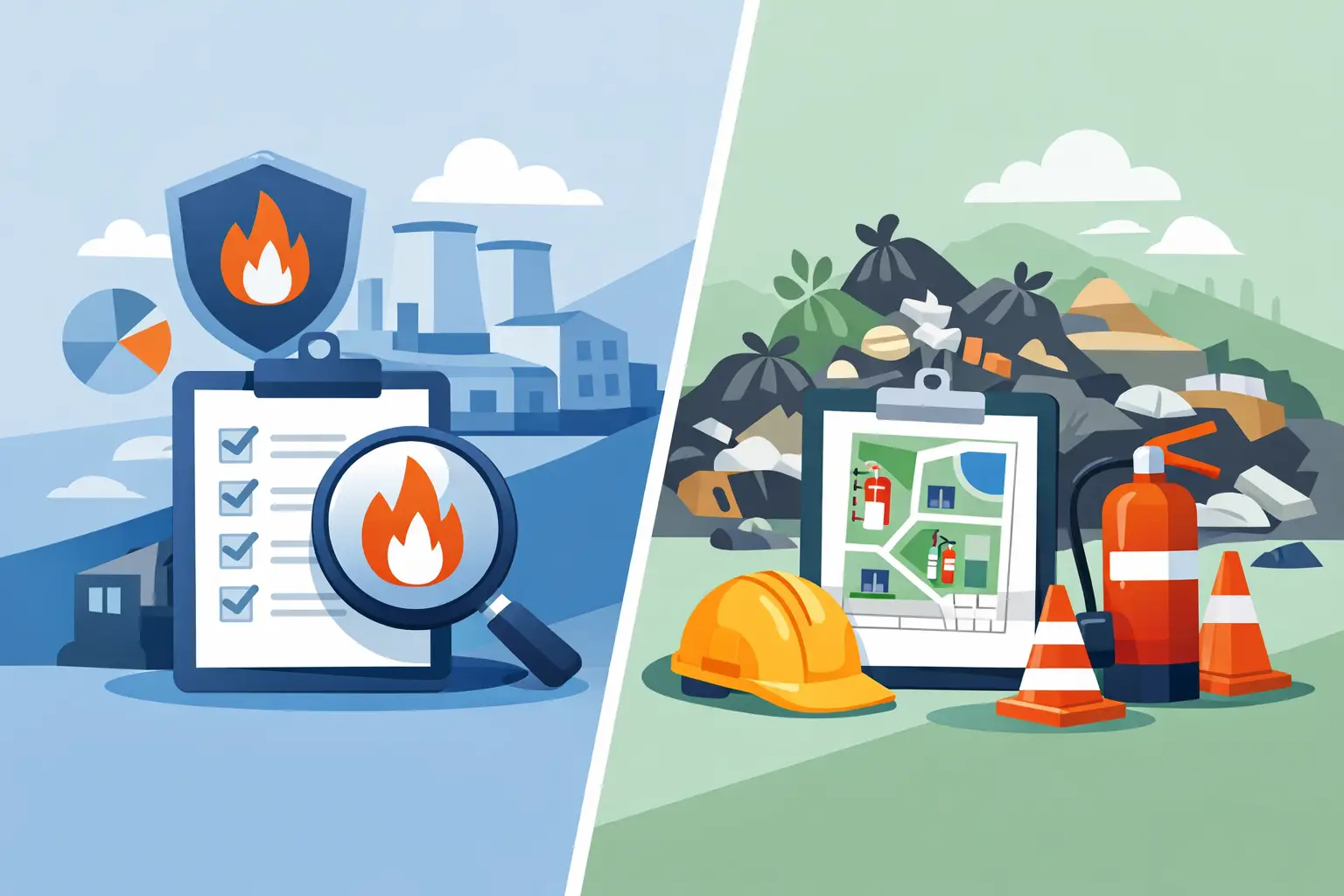
A fire involving waste can develop rapidly, affect neighbouring businesses and communities, interrupt operations for months, and draw close regulatory scrutiny. For permitted operators, the distinction between a fire risk assessment versus plan is therefore more than a paperwork issue. Each document addresses a different risk, serves a different legal and operational purpose, and needs to reflect the conditions on the ground.
A fire risk assessment considers the safety of people. A Fire Prevention Plan considers how a site will prevent, detect, control and mitigate fires involving waste and protect the environment. They should be aligned, but one is not a substitute for the other.
Fire risk assessment versus plan: the essential difference
A fire risk assessment is generally required under the Regulatory Reform (Fire Safety) Order 2005 in England and Wales. The responsible person must identify fire hazards, people at risk, and the measures needed to keep employees, visitors, contractors and others safe. It is principally a life-safety document.
A Fire Prevention Plan, often called an FPP, is a site-specific operational document for waste facilities. It is commonly required by the Environment Agency as part of an environmental permit application, a permit variation or ongoing compliance activity. Its focus is wider than evacuation: it addresses the risks created by the waste accepted, stored, handled and processed on site, including smoke, firewater, pollution and impacts beyond the boundary.
The practical distinction is straightforward. Your fire risk assessment asks, “Can people escape safely, and are they protected from fire?” Your Fire Prevention Plan asks, “How will we stop a waste fire occurring, limit its spread, respond effectively, and prevent environmental harm if one does occur?”
Both questions matter. Treating them as interchangeable can leave gaps in compliance and, more seriously, in site controls.
What a fire risk assessment should address
The responsible person should ensure that the fire risk assessment reflects the actual premises, occupancy and working arrangements. For an industrial or waste operation, this will normally consider ignition sources such as electrical equipment, vehicle movements, hot works, heating systems, smoking, battery charging and arson.
It also examines combustible materials, compartmentation, escape routes, alarm and detection arrangements, emergency lighting, fire-fighting equipment, signage, assembly points and staff training. The assessment should identify people who may be especially at risk, including lone workers, visitors unfamiliar with the site, night-shift staff and contractors.
The result should be proportionate but specific. A generic assessment copied from another facility rarely accounts for the realities of a waste site, where plant layouts change, stock areas move, temporary storage is introduced and operational pressures can affect housekeeping.
A suitable and sufficient assessment leads to clear actions. These may include improving escape-route management, introducing hot-work controls, testing alarms, maintaining extinguishers, reviewing evacuation arrangements or providing staff with fire-safety instruction. Actions need owners and target dates, rather than being left as general recommendations.
What a Fire Prevention Plan should address
A Fire Prevention Plan is built around the waste and processes that create the fire risk. It needs to demonstrate to the regulator that the operator understands those risks and can manage them throughout normal operations, abnormal events and an emergency.
The plan should define the waste streams accepted and explain their fire characteristics. This is particularly relevant where sites receive mixed waste, wood, RDF, SRF, paper, plastics, end-of-life vehicles, batteries, hazardous wastes or materials susceptible to self-heating. The acceptance process is critical: unacceptable material, lithium-ion batteries, gas cylinders and hot loads can enter a site unless staff have clear inspection, quarantine and rejection arrangements.
It should also set out how waste will be stored. That includes maximum pile sizes, separation distances, stock rotation, storage times, access routes, containment, fire breaks and the location of plant or buildings. These controls need to match the approved site layout and the capacity limits in the environmental permit. A plan that permits stockpiles larger than the available space or relies on access routes that are routinely blocked will not be credible in practice.
Detection and response arrangements are equally important. Depending on the site and materials handled, appropriate measures may include routine temperature monitoring, thermal imaging, visual inspections, CCTV, automatic detection, security controls and out-of-hours escalation. The plan should state what triggers an intervention, who makes decisions, how waste is isolated or moved safely, and when the fire and rescue service and regulator will be contacted.
For waste sites, firewater management is often a central consideration. Firewater contaminated by ash, oils, metals, chemicals or waste residues can cause significant pollution if it reaches surface water, groundwater or drainage systems. The FPP should describe drainage isolation, containment capacity, shut-off valves, bunding, interceptor arrangements, drain plans and procedures for protecting receptors. This must be consistent with the site’s environmental management system and pollution incident arrangements.
Why the documents need to work together
Although their purposes differ, the controls in both documents must not conflict. For example, an FPP may identify a need for large separation distances between waste piles, while the fire risk assessment requires clear escape routes through the same operational area. The final layout must achieve both.
Similarly, a fire risk assessment may require staff to evacuate immediately when an alarm sounds. The FPP may include trained personnel using plant to create a fire break or move an unaffected waste pile. The emergency procedure must make clear when evacuation takes priority, who is authorised to act, and when no further intervention is safe.
Training is where plans often succeed or fail. Site operatives need to understand acceptance controls, quarantine arrangements, daily inspections and what to do if they identify heat, smoke or a suspected battery. Supervisors need authority to stop acceptance or processing where controls are not being followed. Managers need to review incidents, near misses and changes in waste composition before they become repeat problems.
Common gaps at permitted waste facilities
The most common weakness is documentation that does not reflect current operations. A site may have expanded its storage area, changed waste streams, added plant or altered traffic routes without updating its fire documents. Even well-written plans become ineffective when they describe a site that no longer exists.
Another issue is over-reliance on a contractor or consultant’s document without embedding it into daily management. An FPP is not complete simply because it has been submitted to the Environment Agency. It must be understood by staff, tested through drills and inspections, and available to those managing an incident.
Operators should also avoid assuming that a small site has a small fire risk. A limited footprint can create its own difficulties, including restricted access, close stockpiles, limited separation from neighbouring premises and insufficient room to quarantine suspect loads. The right controls depend on the waste type, quantities, building construction, surroundings, drainage and available resources.
Keeping assessments and plans current
Both documents should be living controls, reviewed on a planned basis and whenever there is a material change. Relevant triggers include accepting a new waste code, increasing storage capacity, changing the site layout, installing new processing equipment, modifying drainage, following a fire or near miss, or receiving regulatory feedback.
A practical review should involve those who run the operation, not only those who manage compliance. Walk the site with the documents in hand. Check stockpile measurements, access routes, isolation points, signage, emergency equipment and actual staff understanding. Compare permitted limits with what is happening on the day.
For operators preparing an environmental permit application or responding to an Environment Agency requirement, early coordination is usually more efficient than revising documents after submission. EWS Consultancy Services Ltd supports waste and environmental operators with Fire Prevention Plans, permit documentation, management systems and implementation-focused training that reflect operational reality.
A fire risk assessment and a Fire Prevention Plan should give site teams clear, workable instructions when pressure is highest. If either document cannot be followed during a busy shift, a difficult delivery or an out-of-hours incident, it is time to review the controls before the next alarm tests them for real.