
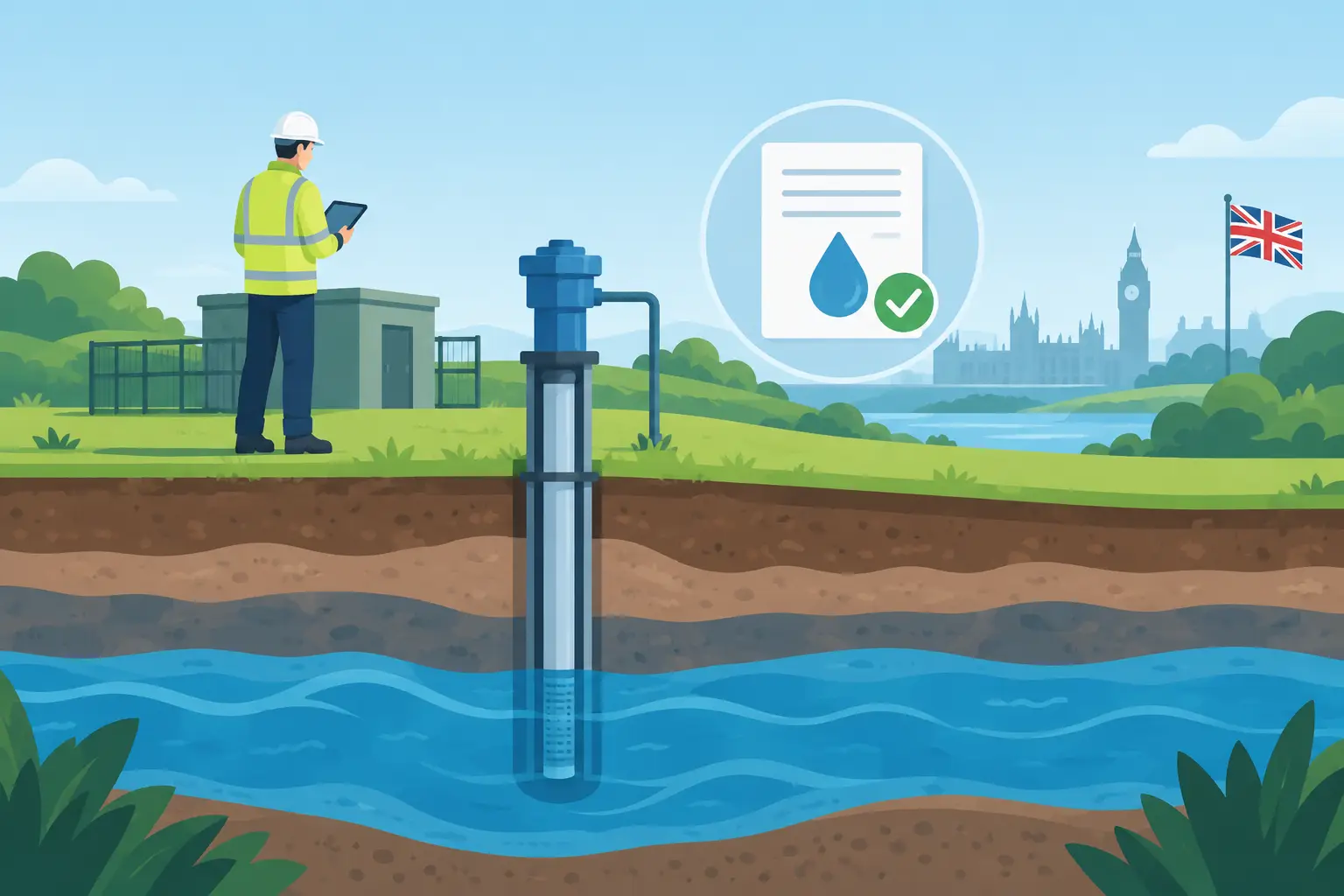
A groundwater permit example is most useful when it shows the regulator’s real concern: not simply what is being discharged or stored on site, but whether contaminants could reach groundwater now or in the future. For waste, remediation and industrial operators, that question needs to be answered with clear technical evidence, workable controls and procedures that site teams can follow.
The example below is illustrative rather than a substitute for a site-specific application. Ground conditions, receptors, operating activities and regulatory requirements differ between sites and across UK jurisdictions. In England, an activity that could cause a direct or indirect discharge of pollutants to groundwater may require a bespoke groundwater activity permit, or changes to an existing environmental permit.
Groundwater permit example: a waste transfer site
Consider a permitted waste transfer station accepting non-hazardous construction and demolition waste, soils and mixed commercial waste. The operator proposes to install a wash-down area for mobile plant and waste containers. Run-off from the area will pass through a silt trap and oil separator before entering a drainage system.
During the initial assessment, it becomes clear that the drainage network includes historic pipework of uncertain condition. The site is underlain by superficial granular deposits above a principal aquifer. A nearby borehole supplies water for agricultural use. Although the proposed wash-down area is relatively small, the combination of potentially contaminated run-off, permeable ground and a sensitive groundwater receptor creates a material permitting risk.
A poor application might state that an oil separator will be fitted and that wash-down water will be controlled. That is not enough. The regulator will need to understand the source of potential pollution, the pathway by which it could move through the ground, the receptors that could be affected, and the measures that will prevent or minimise the risk.
The proposed activity
The application should describe the activity in operational terms. For this example, the operator would explain that wash-down is limited to plant, containers and hardstanding associated with the waste operation. It would identify likely contaminants, including suspended solids, hydrocarbons, metals, detergents and trace contaminants carried in waste residues.
The description should also state what will not be accepted. For example, the wash-down area may not be used for cleaning tankers, hazardous waste containers or equipment contaminated with chemicals outside the site’s approved waste activities. Defining these limits prevents a broad proposal from becoming difficult to control in practice.
The application would confirm anticipated wash-down frequency, estimated volumes, drainage routes and whether water is discharged, collected for off-site removal, recirculated or sent to foul sewer under the relevant consent. These details matter because a drainage system that is suitable for clean surface water may not be appropriate for operational run-off.
Source-pathway-receptor assessment
The core technical document is usually a risk assessment built around the source-pathway-receptor model. It should not be a generic statement copied from another site. It needs to reflect the actual layout, geology and operational controls.
In this groundwater permit example, the sources include contaminated wash-down water, spills during refuelling or maintenance, and sediments accumulated in drainage features. Pathways include defects in hardstanding, cracked drains, poorly sealed interceptors, soakaways, historic drainage runs and vertical migration through permeable deposits. Receptors include the principal aquifer, the agricultural borehole and potentially connected surface waters.
The assessment should explain how the site’s geological and hydrogeological setting has been established. Depending on the risk, this may involve borehole records, groundwater level information, geological mapping, previous site investigation reports, drainage surveys and monitoring data. Where evidence is incomplete, the application should say so directly and set out how uncertainty will be resolved.
A regulator is more likely to accept an application that identifies uncertainty and proposes proportionate investigation than one that presents assumptions as fact.
Evidence and controls expected in the application
For the wash-down proposal, the operator may need to provide a drainage plan that clearly distinguishes clean water, foul water and potentially contaminated operational drainage. The plan should show the wash-down area, gullies, pipework, treatment equipment, isolation points, discharge points and any former or redundant drainage.
The following information would normally strengthen the application:
- site location and permit boundary plans, with nearby water features and abstraction points identified;
- a detailed drainage plan and, where relevant, a CCTV drainage survey;
- ground investigation and hydrogeological information proportionate to the risk;
- a source-pathway-receptor risk assessment;
- operating procedures for wash-down, spill response, inspections and maintenance;
- specifications and maintenance arrangements for drainage treatment equipment;
- a monitoring and contingency plan where required.
The physical controls must be credible. In this case, the operator may install an impermeable wash-down pad with contained falls to a dedicated drainage system. The system could incorporate a silt trap, oil separator and shut-off valve, but only where the equipment is properly designed for the expected flow and contaminants. Treatment equipment does not remove the need for disciplined operations and regular maintenance.
The operational procedure should specify who can authorise wash-down, what areas and materials can be cleaned, how detergents are controlled, and what happens if a spill or unusual waste residue is identified. It should include inspection frequencies for gullies, separators and hardstanding, plus a clear escalation route for defects. These arrangements need to be practical for the site manager and operatives, not simply written to satisfy an application requirement.
Monitoring, maintenance and contingency
Monitoring requirements depend on the risk profile. At a lower-risk site, routine inspections, maintenance records and incident reporting may be sufficient. At a more sensitive location, the regulator may expect groundwater monitoring boreholes, defined sampling parameters, trigger levels and a response plan.
For this example, the uncertainty around historic drainage could justify a phased approach. Before commissioning the wash-down area, the operator could carry out a drainage integrity survey and repair or remove redundant pipework. If monitoring is required, baseline groundwater data should be collected before the new activity begins wherever possible.
A contingency plan should address realistic failures. If the separator alarms, a gully blocks or an unplanned release occurs, staff must know how to isolate drainage, contain the material, notify management and arrange waste removal or specialist support. Emergency controls are only effective if isolation valves are accessible, clearly marked and tested.
Common weaknesses in groundwater permit applications
Applications are often delayed because the supporting information does not connect the proposed activity to the environmental risk. A drainage drawing may show pipe routes but omit discharge points or treatment stages. A risk assessment may identify a nearby aquifer without explaining whether contaminants can reach it. An environmental management system may promise inspections without naming frequencies, responsibilities or records.
Another common issue is relying on standard drainage features as proof of protection. An interceptor may be appropriate for certain hydrocarbon risks, but it will not manage every contaminant or compensate for poor housekeeping. Similarly, a concrete surface cannot be assumed impermeable if it is cracked, unsealed or penetrated by drains and service ducts.
Operators should also avoid treating the permit application as a one-off exercise. If waste types, site layout, drainage arrangements or operating methods change, the groundwater risk assessment may need review. A permit variation, amended procedures or additional infrastructure could be required before the change is implemented.
Building an application that works on site
The strongest applications are prepared by combining technical assessment with an understanding of daily operations. Site staff often hold essential information about where water ponds, which drains block, how waste is handled during busy periods and where historic infrastructure remains uncertain. Their input can make the difference between theoretical controls and arrangements that work under pressure.
For operators managing several environmental obligations, the groundwater assessment should align with the wider permit, Environmental Management System, accident management plan and staff training. Contradictions between documents can create avoidable regulatory questions and make compliance harder to demonstrate during an inspection.
EWS Consultancy Services supports operators with practical, evidence-led permitting documentation and implementation support. The objective is not to produce paperwork in isolation, but to establish controls that protect groundwater and can be maintained through normal site operations.
Before submitting any application, test it against a straightforward question: can a regulator see exactly what could pollute groundwater, how it could get there, and what will stop it? If the answer is clear in both the documents and the site arrangements, the application is on a far stronger footing.