
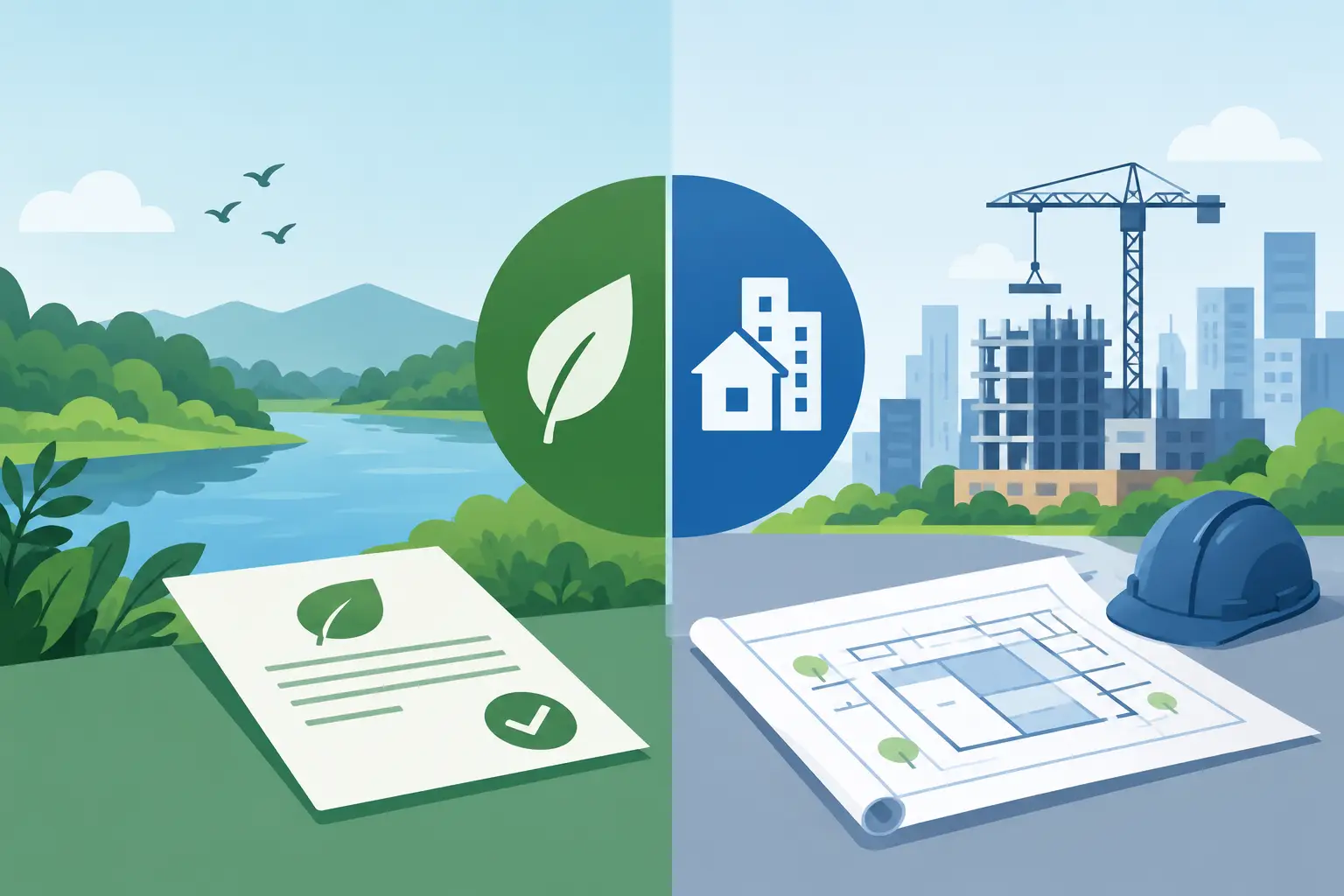
A proposed waste transfer station may be acceptable in planning terms yet be unable to operate until its environmental permit is in place. Equally, a technically sound permit application will not override a planning restriction on land use, operating hours or vehicle movements. Understanding environmental permit versus planning permission early is therefore essential for any operator developing, expanding or regularising a waste or industrial site.
The two permissions are separate, issued by different regulators and assessed against different legal tests. They often rely on overlapping site information, but they answer different questions. Treating one as a substitute for the other is a common cause of delay, unexpected design changes and avoidable compliance risk.
Environmental permit versus planning permission: the core difference
Planning permission controls whether a proposed development or use of land is acceptable at a particular location. It is usually determined by the local planning authority. The assessment considers matters such as the principle of development, land-use policy, visual impact, highways, noise, drainage, ecology, amenity and effects on neighbouring properties.
An environmental permit controls how a regulated activity is carried out once it is operating. In England, it is generally regulated by the Environment Agency under the Environmental Permitting Regulations, although some activities fall under local authority regulation. For waste facilities, this may include the acceptance, storage, treatment, recovery or disposal of waste. The permit sets operational boundaries and conditions intended to prevent pollution and protect people and the environment.
In simple terms, planning permission is primarily concerned with the site and proposed development. An environmental permit is concerned with the activity, its environmental risks and the controls needed to manage them.
Neither approval automatically delivers the other. A planning consent may state that no waste operations can begin until an environmental permit has been obtained. Conversely, the Environment Agency may ask for evidence that the proposed activity is consistent with planning status before determining a permit application.
What planning permission normally covers
A planning application establishes the acceptability of development and use at the site. For a waste operator, this could involve a change of use to a waste management facility, construction of a new building, installation of plant, extension of a yard, creation of storage bays or changes to access arrangements.
Planning conditions can have a direct operational effect. A permission may limit the types of waste that can be handled, set maximum throughput, restrict operating hours, require wheel washing, control external storage heights or specify approved drawings that fix the site layout. These conditions remain enforceable after the development has been completed.
This is particularly significant where a business is acquiring an existing site. The buildings may look suitable and a previous operator may have carried out waste activities there, but the current planning consent may not permit the intended use, scale or working arrangements. Historic activity is not, by itself, proof of lawful planning status.
What an environmental permit normally covers
An environmental permit assesses the risks arising from the regulated activity and the measures used to control them. The application needs to show that the operator understands the waste, processes, emissions pathways and potential impacts associated with the site.
For a waste operation, permit controls may address waste acceptance and classification, storage limits, treatment processes, drainage, dust, odour, noise, litter, pests, fire risk, emissions to air or water, and the competency of the operator. The approved operating techniques and permit conditions become the practical framework for running the facility.
The level of assessment depends on the activity. A Standard Rules Permit may be appropriate where the activity, waste types and site circumstances fit a published rule set. A Bespoke Permit is required where the operation falls outside those rules or needs site-specific controls. Neither route should be selected on speed alone. The correct route depends on the activity proposed, environmental sensitivity, infrastructure and the operational flexibility the business requires.
Supporting documents often include an Environmental Management System, Fire Prevention Plan, drainage information, site plan, operating procedures and evidence of technically competent management. These documents should be workable on site, rather than produced solely to support an application.
Why the two processes overlap
Although their legal purposes differ, planning and permitting frequently examine the same physical site and operational proposal. Both regulators need a clear picture of what will happen, where it will happen and what controls will apply.
A planning drawing may show a building, waste bays, plant, access and drainage. The environmental permit application may rely on the same layout to demonstrate quarantine arrangements, fire breaks, impermeable surfacing, containment and traffic segregation. If the plans differ, regulators may question whether the proposal has been properly assessed.
Fire prevention is a good example. Planning may consider the position and scale of external waste storage, proximity to neighbouring land and emergency access. The permit process considers the combustible materials present, maximum pile sizes, separation distances, detection arrangements, fire-fighting water and a plan to reduce the likelihood and impact of a fire. A layout that satisfies one process may still need adjustment to satisfy the other.
When both permissions are likely to be needed
Many new waste, recycling, treatment, remediation and industrial operations will need both planning permission and an environmental permit. This is commonly the case where a site is changing use, new buildings or infrastructure are proposed, operational capacity is increasing, or a previously unregulated activity is becoming a permitted facility.
There are exceptions. An existing site may already have suitable planning permission, meaning that no new planning application is required for the intended operation. Some minor works may be permitted development, subject to the relevant limitations and prior approval requirements. Similarly, not every industrial activity requires an environmental permit.
The correct answer depends on the site history, the exact activity, waste streams, process capacity, proposed works and local planning controls. Operators should also consider whether a permit variation is needed. A material change to waste types, storage quantities, treatment plant, operating techniques or site boundary can require prior approval from the Environment Agency even where planning permission is unchanged.
The risks of dealing with permission in the wrong order
There is no universal sequence that suits every project, but the two workstreams should be considered together from the outset. Starting an environmental permit application without checking planning constraints can result in a design that cannot be delivered. Waiting for planning to be finalised before considering permit requirements can leave the business with an approved building but no compliant operating model.
The most costly issues tend to emerge late: insufficient fire-water containment, inadequate drainage segregation, waste storage areas that do not meet the Fire Prevention Plan, an inappropriate building arrangement, or planning conditions that conflict with the proposed permit capacity. Altering these features after submission can extend determination times and disrupt construction programmes.
A coordinated approach allows the site layout, operational capacity and control measures to be tested before applications are submitted. It also helps ensure that descriptions of the activity, waste types, hours, vehicle movements and storage arrangements are consistent across all documents.
A practical approach before committing to a site
Before signing a lease, purchasing land or ordering plant, establish the planning and permitting position in detail. Review the planning history, existing conditions, lawful use, environmental sensitivities, drainage arrangements and physical constraints. Confirm what activity is proposed, the anticipated waste types and volumes, and whether the planned process sits within Standard Rules or requires a Bespoke Permit.
The proposed layout should then be assessed as an operating site, not simply as a planning drawing. Consider vehicle movements, waste inspection, quarantine, storage duration, fire separation, drainage, loading, staff welfare and emergency access. These practical details are where many otherwise credible proposals fail to align.
Early dialogue with the relevant regulators can be valuable where a proposal is complex or unusual. However, informal advice should support, rather than replace, a properly evidenced application and a site-specific compliance strategy.
Maintaining compliance after approval
Obtaining permissions is only the start. Planning conditions and permit requirements must be translated into day-to-day controls that site teams can follow. This includes maintaining records, checking incoming waste, controlling storage, inspecting infrastructure, managing non-conformances and training staff on the procedures that apply to their role.
Where operations change, review both permissions before implementation. A new waste stream, additional shredder, extended operating hours or revised external storage arrangement may create planning, permitting or fire prevention implications. The commercial benefit of a change can quickly be outweighed by enforcement risk if the required approvals are overlooked.
For operators managing complex sites, experienced support can bring planning assumptions, permit requirements and practical operations into one workable proposal. EWS Consultancy Services helps clients prepare applications and implementation-ready documentation that reflects how a site will actually operate.
The most reliable projects are not those that secure paperwork fastest. They are the ones designed from the beginning around a clear, consistent and deliverable operating model – one that can satisfy both the planning authority and environmental regulator, and still work safely on the ground.