
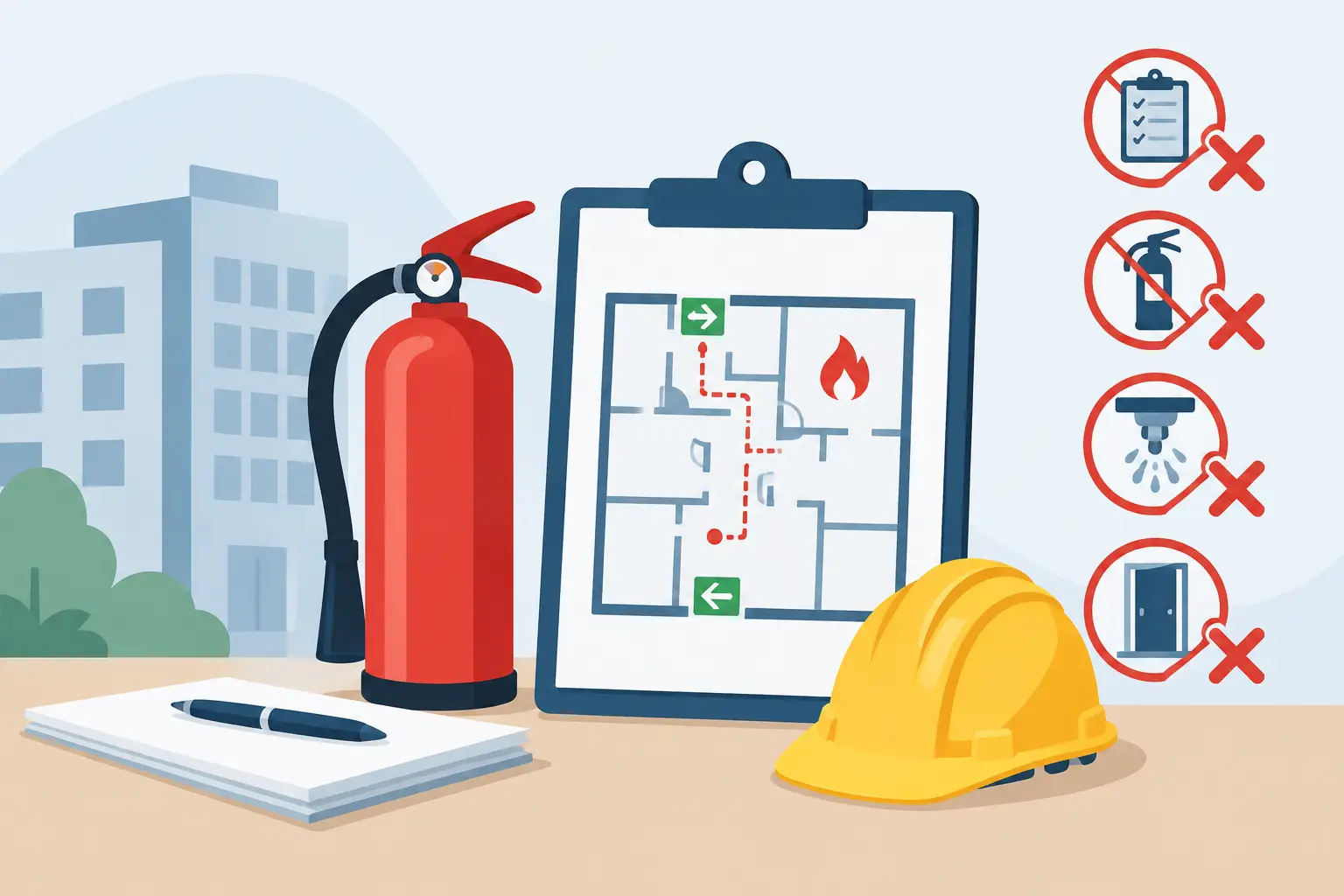
A Fire Prevention Plan is tested when a site is under pressure: inbound loads are building, plant is unavailable, staff are stretched and a hot load arrives at the gate. The top fire prevention plan errors are rarely caused by an absence of paperwork. More often, they arise when a plan describes an ideal operation rather than the way materials, people and equipment actually move around site.
For permitted waste facilities, the consequences are significant. A fire can affect permit compliance, local communities, staff safety, business continuity and the confidence of the regulator. A credible plan must therefore be a working operational control, understood by the team and capable of being followed on an ordinary busy day.
1. Treating the plan as a document rather than a site control
A plan may be technically well written but ineffective if it is stored in a shared folder and only reviewed before an inspection or permit application. Fire prevention depends on decisions made on the ground: where a load is tipped, how high a pile becomes, whether contamination is isolated and who has authority to stop acceptance.
The plan should match current site layouts, waste streams, traffic routes, machinery, staffing and operating hours. If the yard has changed, a new bay has been introduced or the waste acceptance criteria have broadened, the plan may no longer reflect the risk being managed.
Site managers should use the plan during inductions, toolbox talks and shift handovers. Supervisors need clear prompts on what to check and what to escalate. This turns a compliance document into a practical instruction set.
2. Using stockpile limits that cannot be maintained
Maximum pile sizes, separation distances and storage times are central controls in most fire prevention plans. A common failure is specifying limits that are realistic on a quiet day but impossible to maintain during seasonal peaks, delayed outbound movements or equipment breakdowns.
The answer is not to set generous limits simply to avoid operational inconvenience. Larger stockpiles can make a fire harder to detect, access and extinguish. Instead, capacity should be calculated against the actual footprint available, waste throughput, likely dwell times and contingency arrangements.
Consider what happens if a shredder or baler is offline for several days, a disposal outlet closes, or severe weather interrupts collections. A workable plan identifies the trigger point before storage reaches its limit and defines the action required, whether that is reducing intake, redirecting material, arranging additional haulage or using an agreed alternative storage area.
Separation is about access as well as distance
A separation gap that is repeatedly occupied by containers, loose material or parked plant is not a separation gap. The same applies where a stockpile is technically within its footprint but cannot be safely reached by plant or emergency responders.
Marking stockpile boundaries and access routes on the ground can be more reliable than relying on judgement alone. Daily inspections should confirm that these areas remain clear, particularly after busy tipping periods.
3. Assuming waste acceptance ends at the weighbridge
Waste acceptance procedures are sometimes written as if the principal risk can be controlled through pre-acceptance paperwork alone. Documentation matters, but it cannot identify every battery, gas cylinder, hot ash load, chemical container or concealed incompatible material.
A strong process has several stages. It checks the source and description of the waste before acceptance, verifies the load on arrival, and gives operatives the authority to reject, quarantine or escalate suspect material. This is especially relevant where loads are mixed, poorly presented or sourced through third parties.
Staff need to know what unacceptable loads look like in practice. Training should use examples relevant to the facility, including damaged lithium-ion batteries, vapes, cylinders, electrical items, reactive materials and evidence of heat or smoke. A vague instruction to report contamination is not enough when fast decisions are required at the tipping face.
4. Failing to manage batteries and other ignition sources
Lithium-ion batteries have changed the fire risk profile of many waste operations. They can be present in household and commercial waste, electrical equipment, small appliances and battery-powered tools. They may be crushed, pierced or damaged before anyone identifies them.
Plans that make only a general reference to batteries often lack the controls needed for site teams. Define how batteries and electrical items will be identified, removed, contained, stored and moved. The arrangement should include a suitable quarantine area, protection from damage, clear labelling and a route for prompt onward management.
Other ignition sources also need site-specific consideration. These can include hot works, vehicle and mobile plant defects, smoking, arson, overheating equipment, friction in processing machinery and hot loads arriving from customers. Different waste streams create different risks, so a copied list of generic controls is rarely sufficient.
5. Writing an emergency response that is too vague to use
During a developing fire, a site team does not have time to interpret broad statements such as ‘contact emergency services and follow procedures’. They need to know who does what, in what order, and where critical information is held.
The emergency section should identify how the alarm is raised, who calls 999, who meets the fire and rescue service, how visitors are accounted for, and how plant is used only where it is safe and appropriate. It should also state the site address, access points, hydrant or water supply details, hazardous areas, shut-off locations and assembly points.
The response must account for out-of-hours conditions. If a fire is detected by CCTV or a monitoring system overnight, who receives the alert? Can they access the latest site plan? Is there a reliable list of contacts for keyholders, management and specialist contractors? These details should be checked, not assumed.
Test the arrangements under realistic conditions
A tabletop exercise can reveal gaps quickly. Run through a scenario involving a fire in a full stockpile, an inaccessible gate, absent key personnel or a failure of mobile phone coverage. Record actions, assign owners and update the plan where needed.
Live drills also have value, provided they are planned safely. They help confirm whether staff can locate equipment, communicate effectively and manage evacuation without creating further risks.
6. Relying on inspections without recording action
Many plans require routine inspections for heat, smoke, odour, abnormal pile conditions, contamination, blocked access and equipment defects. The weakness appears when checks are recorded as complete but no evidence shows how defects were resolved.
Inspection records should be proportionate, but they must establish a clear chain from finding to action. If a pile has exceeded its permitted height, the record should show when it was identified, what material was moved, who was responsible and when compliance was restored.
Thermal monitoring may be appropriate for some higher-risk operations, but it is not a substitute for competent visual checks and good housekeeping. A camera or temperature reading only helps if someone reviews it, understands the trigger thresholds and has the authority to act.
7. Overlooking housekeeping, drainage and access routes
Combustible debris around processing equipment, blocked drainage, accumulated dust and obstructed roads can turn a manageable incident into a more serious one. These matters are sometimes treated as general housekeeping, separate from fire prevention. In reality, they are connected.
Poor drainage can allow contaminated firefighting water to escape or collect where it cannot be controlled. Blocked routes may delay access for the fire and rescue service. Unmanaged waste around plant can provide fuel and make routine maintenance more difficult.
Daily site checks should include practical controls such as keeping drainage features clear, maintaining emergency access, managing litter and loose material, and removing combustible waste from unsuitable areas. The required frequency depends on the operation, weather and material handled, but responsibility should always be explicit.
8. Not reviewing the plan after change or near miss
The final of the top fire prevention plan errors is treating review as an annual administrative task. Formal review dates are necessary, but a plan should also be reassessed after a fire, near miss, significant waste rejection, equipment change, capacity increase, layout alteration or regulator feedback.
Near misses are particularly useful. A smoking load that was isolated before ignition, a battery found on a picking line or repeated blocked access routes all indicate that a control may need strengthening. Investigating these events properly is far less disruptive than responding to a fire.
Changes should be communicated to the people who apply the plan. Revised drawings, procedures and storage limits need to reach supervisors, operatives, agency staff and contractors, not just the compliance file.
A Fire Prevention Plan is most effective when it reflects the realities of the site and gives people clear, workable choices under pressure. Independent review can be valuable where operations have evolved, permit requirements are changing or a team needs confidence that its controls will stand up to regulatory scrutiny. EWS Consultancy Services supports operators with practical, implementation-ready fire prevention documentation and the operational insight needed to keep it current.