
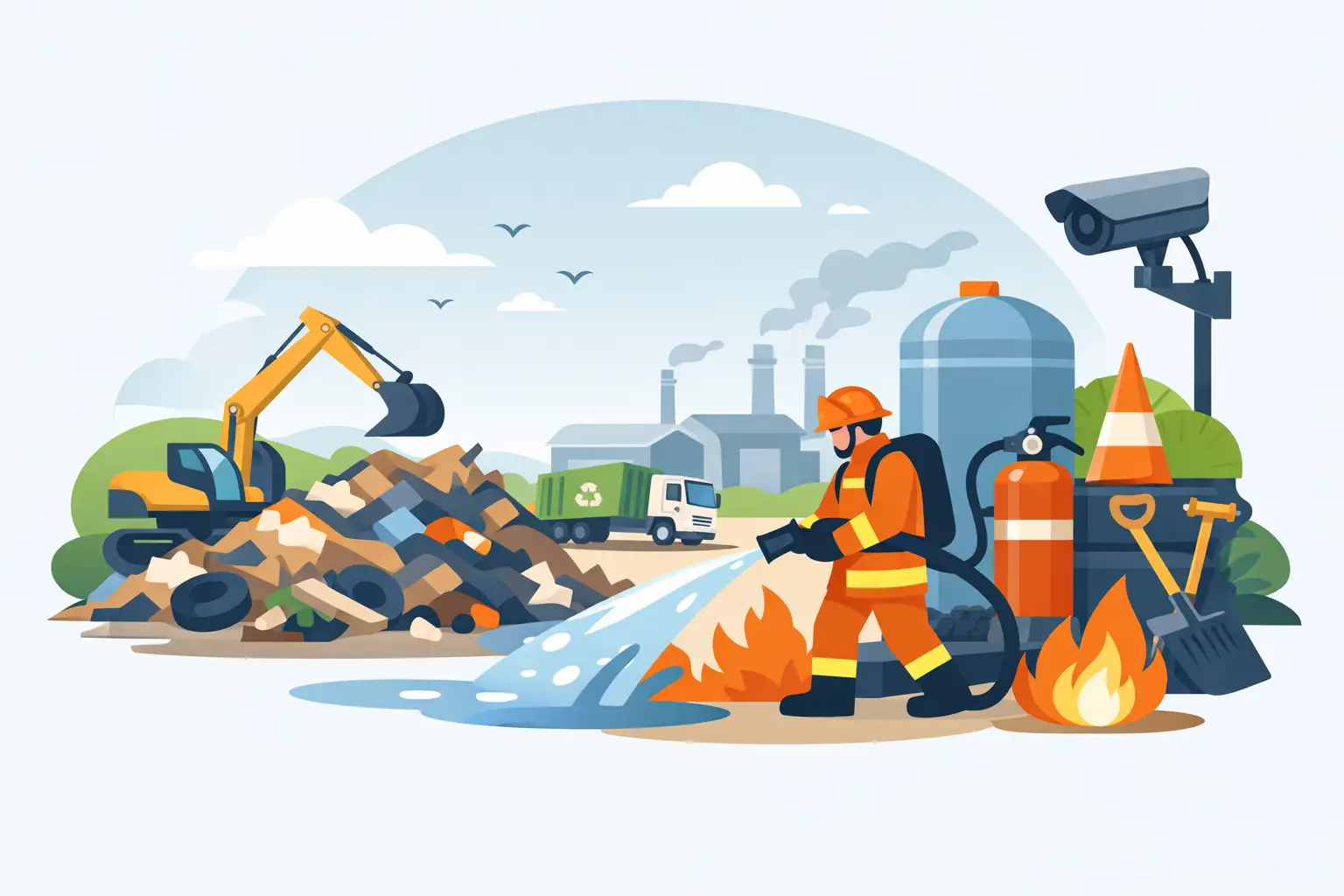
A fire on a waste site rarely starts as a dramatic event. More often, it begins with heat building unnoticed inside a stockpile, poor separation between materials, a battery hidden in incoming loads, or an operational control that exists on paper but not in daily practice. That is why businesses need to prepare waste site fire prevention measures properly, with controls that reflect how the site actually receives, stores, moves and treats waste.
For UK operators, this is not just a matter of good housekeeping. Fire prevention is closely tied to environmental permitting, site design, management systems and the ability to demonstrate to regulators that risk is understood and controlled. A credible approach protects people, keeps the site operational and reduces the likelihood of enforcement action, pollution incidents and costly disruption.
What prepare waste site fire prevention really involves
Preparing for fire prevention on a waste site is not limited to writing a Fire Prevention Plan. The document matters, but regulators will also look at whether the site layout, stock management, staffing, inspection routines and emergency response arrangements support what the plan says.
In practice, preparation starts with a realistic assessment of the wastes handled and the processes carried out. Sites accepting combustible materials, mixed wastes, wood, RDF, SRF, metals containing contaminants, end-of-life vehicles or materials with a risk of hidden ignition sources will face different hazards. The same is true for sites that shred, sort, bulk, transfer or store waste over extended periods. Fire risk changes with material type, moisture content, storage duration, turnover speed and seasonal conditions.
A useful plan is therefore site-specific. It should explain not only what the risks are, but how the operator will prevent a fire starting, detect problems early and limit escalation if an incident occurs. Generic wording is one of the quickest ways to undermine confidence in a submission.
Start with the waste, not the paperwork
One of the most common weaknesses in fire prevention planning is beginning with a template and trying to fit the site into it. A stronger approach is to map actual operations first.
Consider what enters the site, how it is inspected, where it is deposited, how long it remains there, how it is processed and where it moves next. If waste acceptance checks are weak, prohibited or higher-risk materials can enter the site unnoticed. If stock rotation is poor, heat can build within piles that appear stable from the outside. If plant movements are congested, emergency access can be compromised at the point it is most needed.
Preparing waste site fire prevention controls properly means identifying these pressure points before the regulator, insurer or emergency services do. It also means being honest about operational realities. If a site regularly experiences seasonal surges in tonnage, reduced haulage availability or delays in off-take, the plan should account for those conditions rather than assuming ideal turnover.
Waste acceptance and inspection
Incoming loads remain one of the main ways ignition sources reach a site. Batteries, gas cylinders, hot loads, flammable contaminants and misdescribed waste all require attention. Effective controls usually include pre-acceptance procedures, clear acceptance criteria, trained staff at the point of receipt and a process for isolating suspect loads.
This is an area where training and supervision matter as much as written procedures. Staff need to recognise warning signs and understand what to do when a load does not meet the agreed specification.
Stockpile management
Maximum stock sizes, separation distances and storage durations are central to fire prevention planning. These controls must be practical for the available footprint and throughput. If the site cannot physically maintain the proposed separation distances at peak periods, the issue needs to be addressed in the design or operating model, not glossed over in the document.
Stock rotation is equally important. Older material is often where hidden heat or decomposition becomes a problem. Operators should be able to demonstrate how they track stock age, prioritise removal and avoid excessive accumulation.
Site layout is a fire control measure
A compliant fire prevention approach is heavily influenced by the physical arrangement of the site. Access routes, quarantine areas, drainage design, surface condition, hydrant or water supply arrangements, and proximity to sensitive receptors all affect how a fire might develop and how manageable it would be.
A site that looks efficient for daily operations is not always resilient in an emergency. Narrow internal routes, poorly defined storage bays or shared plant areas can hinder firefighting access and make separation difficult. Likewise, drainage that is acceptable under routine conditions may be inadequate if contaminated fire water needs to be contained.
When reviewing layout, operators should ask practical questions. Can emergency services reach all relevant storage areas? Is there enough room to isolate a suspect load quickly? Are high-risk wastes stored away from boundaries, buildings and other combustible materials? Can contaminated run-off be directed and contained without causing wider pollution?
These details matter because fire prevention is not assessed in isolation. It sits alongside broader permit compliance and environmental protection duties.
Detection, monitoring and early intervention
Not every site needs the same level of technology, and there is no single control that suits all waste streams. What matters is that the monitoring regime reflects the risk profile.
For some operators, routine visual inspections and temperature checks may be suitable where stock is small, turnover is rapid and materials are lower risk. For others, especially where larger combustible stockpiles or complex mixed wastes are involved, more structured monitoring may be necessary. Thermal imaging, formal inspection records, trigger levels for intervention and defined escalation routes can all help.
The key point is consistency. If a plan states that piles will be inspected daily, records and site practice should support that claim. If hot spots are identified, staff should know when to turn, isolate, damp down or remove material and when the matter requires external assistance.
The permit position cannot be treated as an afterthought
On regulated sites, fire prevention arrangements need to align with Environmental Permit requirements and with current regulatory expectations. That includes the details set out in the Fire Prevention Plan itself, but also the wider operating techniques described in the permit application, management system and supporting documents.
Problems often arise when documents have been prepared at different times by different people. The permit may describe one storage arrangement, the site plan another and the Fire Prevention Plan something else again. Those inconsistencies create unnecessary risk during permit determination, compliance inspections and incident response.
For that reason, operators should review fire prevention as part of the wider compliance framework. Changes to waste types, tonnage, storage methods, treatment activities or site infrastructure may all affect whether the current plan remains accurate. A Fire Prevention Plan is not something to prepare once and leave untouched for years.
Prepare waste site fire prevention through people and systems
Even a well-designed site can fail if staff are unclear on responsibilities. Fire prevention depends on routine behaviours – load checks, stock recording, housekeeping, plant maintenance, separation of materials, incident reporting and escalation.
That means responsibilities should be clear at every level. Site managers need oversight of stock control and compliance. Supervisors need authority to stop unsuitable loads or direct corrective action. Operatives need practical instruction, not just induction paperwork. Contractors and visitors should also be managed so that ignition risks linked to hot works, smoking controls or plant movements are properly controlled.
A formal Environmental Management System can help by giving structure to inspections, corrective actions, document control and training records. The benefit is not administrative neatness for its own sake. It is the ability to show that fire prevention controls are being implemented, checked and updated as operations change.
Emergency planning must be workable under pressure
Many plans describe what should happen in an incident, but fewer reflect what can realistically happen at 3 am, in poor weather, with limited staff on site and a rapidly developing fire.
Emergency procedures should therefore be tested against likely scenarios. Who is called first? Who has authority to isolate areas or stop incoming loads? How is access kept clear for emergency services? Where are site plans, drainage information and hazardous material details held? If fire water is likely to become contaminated, how will containment measures be activated?
The right level of detail will depend on the site, but the principle is straightforward. Emergency arrangements should be specific enough to be useful, simple enough to follow and consistent with the physical constraints of the site.
This is also where external support can add value. Experienced consultancy input can help operators align permit obligations, site realities and regulatory expectations into documentation that is technically sound and usable in practice.
Common gaps that delay approval or create compliance risk
Across the sector, similar weaknesses appear repeatedly. Fire prevention plans often fail because stock limits are not credible, separation distances are not achievable, drainage controls are unclear, or inspection and response arrangements are too vague. In other cases, the issue is not the document itself but the absence of supporting systems on site.
Operators are usually best served by addressing these points early, before submitting a permit application or responding to regulatory queries. A stronger plan is one that can be defended operationally, not just presented neatly.
For businesses managing busy waste operations, the goal is not perfection in theory. It is a practical, evidence-based system that reduces the chance of fire, supports permit compliance and stands up to scrutiny. That is the standard expected by regulators and the standard that protects the continuity of the business.
If your site is changing, your permit is under review or your current arrangements no longer reflect day-to-day operations, that is usually the right moment to revisit fire prevention properly rather than wait for a problem to expose the gap.