
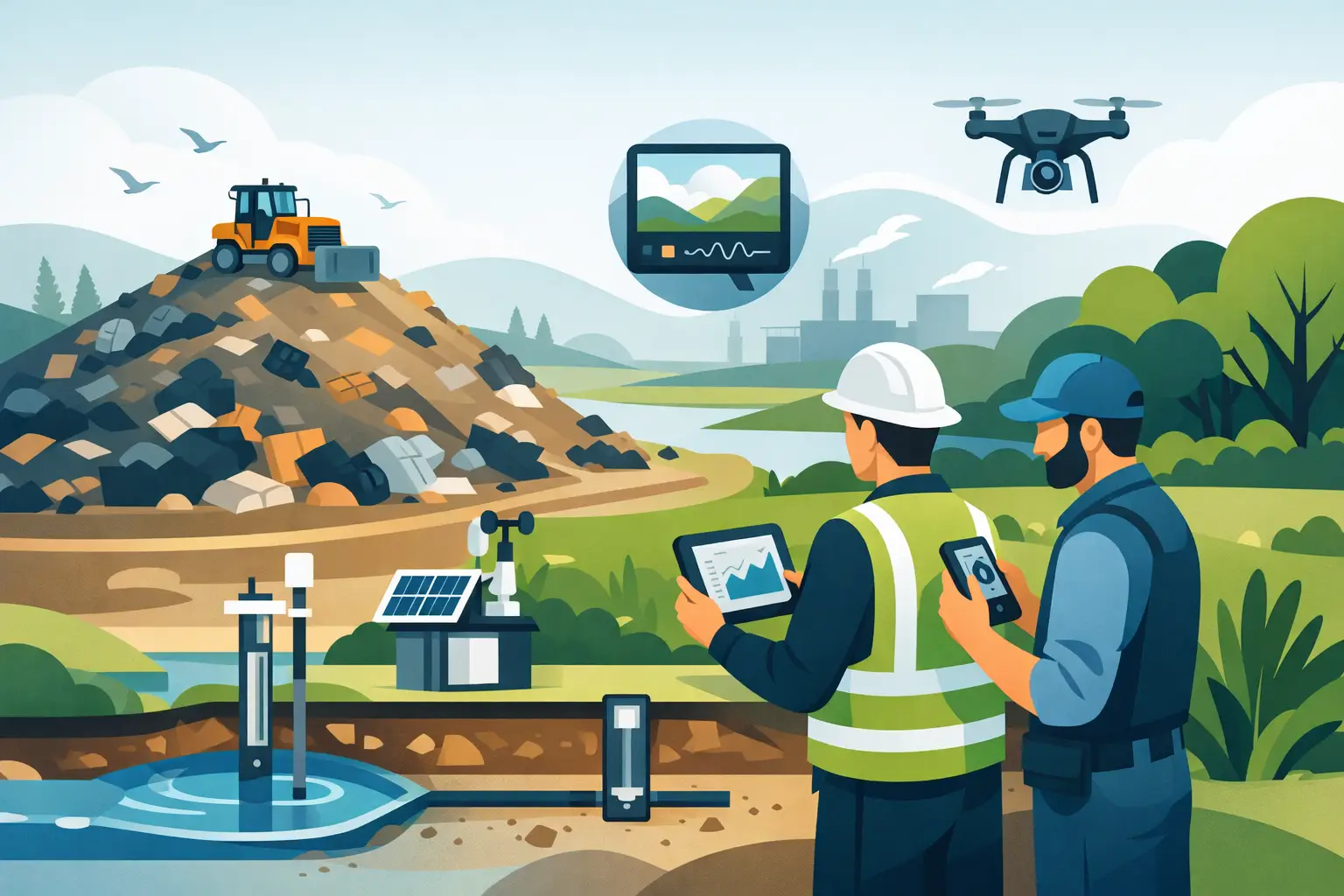
A landfill’s environmental performance is often judged by the quality of its evidence as much as by what happens on site. Effective landfill monitoring methods give operators the information needed to identify change early, demonstrate compliance with permit conditions and take proportionate action before an issue becomes an enforcement matter.
For UK landfill operators, monitoring is not a stand-alone sampling exercise. It must reflect the Environmental Permit, the site’s environmental setting, the landfill design and the risks created by the waste accepted. Results also need to be interpreted in context, recorded properly and translated into clear operational decisions.
What landfill monitoring needs to achieve
A monitoring programme should show whether the containment, control and management measures at a landfill are performing as intended. This commonly includes understanding landfill gas generation and migration, leachate quality and levels, groundwater quality, surface water quality, emissions, settlement and restoration performance.
The precise requirements depend on the permit and site-specific risk assessment. A closed landfill with a completed cap presents different risks from an active cell receiving biodegradable waste. Likewise, a site above sensitive groundwater or close to residential receptors may require closer control, additional monitoring points or more frequent assessment.
Monitoring data only becomes useful when it is compared with suitable baseline information, compliance limits, trigger levels and previous trends. A single result outside the expected range may be caused by sampling conditions, laboratory variation or a temporary operational change. Repeated movement in the same direction, however, may indicate a developing problem that requires investigation.
Landfill monitoring methods used on UK sites
Landfill gas monitoring
Landfill gas monitoring is central to controlling odour, fire, explosion and off-site migration risks. Gas wells within the waste mass are monitored to assess gas quality, pressure, flow and extraction performance. Typical parameters include methane, carbon dioxide, oxygen and balance gas, with readings helping operators adjust extraction systems and identify potential air ingress.
Perimeter boreholes and in-ground gas monitoring points provide evidence of whether gas is migrating beyond the engineered containment. Monitoring may also be required at buildings, service ducts and other sensitive features where gas could accumulate. The frequency and location of checks should be driven by the permit, gas risk assessment and the condition of the landfill.
Surface emissions monitoring can provide another line of evidence, particularly where cap integrity, odour or fugitive emissions are concerns. Portable instruments, flux-box surveys and targeted inspections each have a place, but they are not interchangeable. The chosen method must answer a defined compliance or operational question.
Leachate monitoring and level management
Leachate is monitored both within the landfill and at any collection, storage or treatment infrastructure. Operators commonly measure leachate levels in wells to confirm that the drainage system is effective and that limits on leachate head are being maintained. Elevated leachate levels can increase pressure on lining systems, affect gas control and make operational areas more difficult to manage.
Leachate quality monitoring may include pH, conductivity, ammoniacal nitrogen, chloride, chemical oxygen demand, metals and other determinands set by the permit or agreed monitoring schedule. Changes in leachate composition can reflect waste inputs, rainfall, age of the waste or reduced treatment performance. They should be assessed alongside operational records rather than in isolation.
Sampling must be representative. Poorly maintained wells, unsuitable purging procedures or cross-contamination can undermine results and make later interpretation difficult. A written sampling procedure, trained personnel and properly maintained equipment are practical controls that protect the reliability of the dataset.
Groundwater monitoring
Groundwater monitoring is used to identify whether landfill-related contaminants may be affecting controlled waters. Boreholes are normally positioned to establish groundwater conditions upgradient of the landfill and to detect potential changes downgradient. Water levels are measured alongside quality parameters, as groundwater flow direction can vary seasonally and influence the significance of results.
Field readings such as pH, temperature, conductivity, dissolved oxygen and redox conditions are often taken before samples are sent for laboratory analysis. These provide immediate information on sampling stability and can help identify anomalous results. Laboratory suites are then selected to reflect the likely contaminants and the permit’s specified determinands.
Groundwater results require careful interpretation. An elevated concentration is not automatically proof of a landfill impact, particularly where there are historical land uses, natural mineralisation or other potential sources nearby. Operators need a conceptual site model, reliable baseline data and a clear understanding of hydrogeology before reaching conclusions or proposing corrective action.
Surface water and drainage monitoring
Surface water monitoring is particularly relevant where the site discharges to a watercourse, lagoon, ditch or drainage network. It can confirm the effectiveness of clean and dirty water separation, identify sediment or contamination issues and support discharge compliance where applicable.
Routine inspections remain as important as laboratory samples. Blocked drains, damaged silt controls, ponding water or poorly managed stockpiles can create problems long before a scheduled sampling round identifies them. During prolonged rainfall, site teams should pay particular attention to drainage routes, leachate infrastructure and exposed restoration areas.
Stability, settlement and infrastructure inspections
Landfill monitoring extends beyond water and gas. Regular inspections of slopes, caps, wells, pipework, leachate chambers and surface-water controls help identify defects that can affect containment or environmental performance. Settlement monitoring may be required to assess the condition of restored areas and maintain the integrity of gas and leachate infrastructure.
Inspection findings should lead to defined actions, ownership and completion dates. A record stating that a defect was observed offers limited protection if there is no evidence that the issue was assessed, prioritised and resolved.
Setting frequencies, triggers and action levels
Permit conditions will establish much of the monitoring framework, but operators should not treat the minimum specified frequency as the only consideration. Additional checks may be appropriate after unusual rainfall, a gas extraction system failure, a new phase of waste emplacement, a complaint or an unexplained trend in results.
A well-managed programme distinguishes between compliance limits and internal trigger levels. Compliance limits are formal requirements that may require notification or specific action when exceeded. Internal triggers sit below those limits and prompt earlier review. This approach gives site teams time to investigate and intervene before a formal breach occurs.
For each trigger, the management system should set out who reviews the result, how quickly they act, what further monitoring may be needed and when the regulator should be informed. The response should be proportionate. Re-sampling may be sufficient for an isolated result with a credible sampling explanation, while persistent change may require hydrogeological review, gas system adjustment or engineering works.
Data quality, records and reporting
Monitoring records should be clear enough for another competent person to understand what was sampled, where, when, how and by whom. This includes location references, weather conditions where relevant, field measurements, chain-of-custody records, laboratory certificates, calibration information and any departures from the method.
Trend charts are often more valuable than raw tables. They make gradual increases in gas concentrations, leachate levels or groundwater determinands easier to spot and support meaningful review at management meetings. Results should also be compared against operational events, such as changes in waste type, cell development, pumping interruptions or capping works.
Where permit reporting is required, submissions must be accurate, complete and made within the specified timescales. Late or poorly explained returns can create avoidable regulatory concern, even where the environmental outcome is acceptable. A documented review process reduces this risk and ensures that abnormal results are not simply filed without action.
Making monitoring work in daily operations
The strongest landfill monitoring arrangements are integrated into site management rather than left solely to external sampling visits. Operators need competent staff who understand why readings matter, when to escalate concerns and how to preserve the integrity of monitoring points. Contractors and laboratory providers also need clear scopes, agreed methods and defined reporting routes.
EWS Consultancy Services supports waste operators with practical permit compliance systems, monitoring procedures and training that can be applied on site. The objective is not to generate more paperwork, but to ensure records, responsibilities and corrective actions stand up to regulatory scrutiny.
A useful next step is to review whether your current monitoring plan still reflects the landfill as it operates now. Permit obligations, site conditions and risk profiles can change over time, and a timely review can turn monitoring data into a practical early-warning system rather than a retrospective compliance record.