
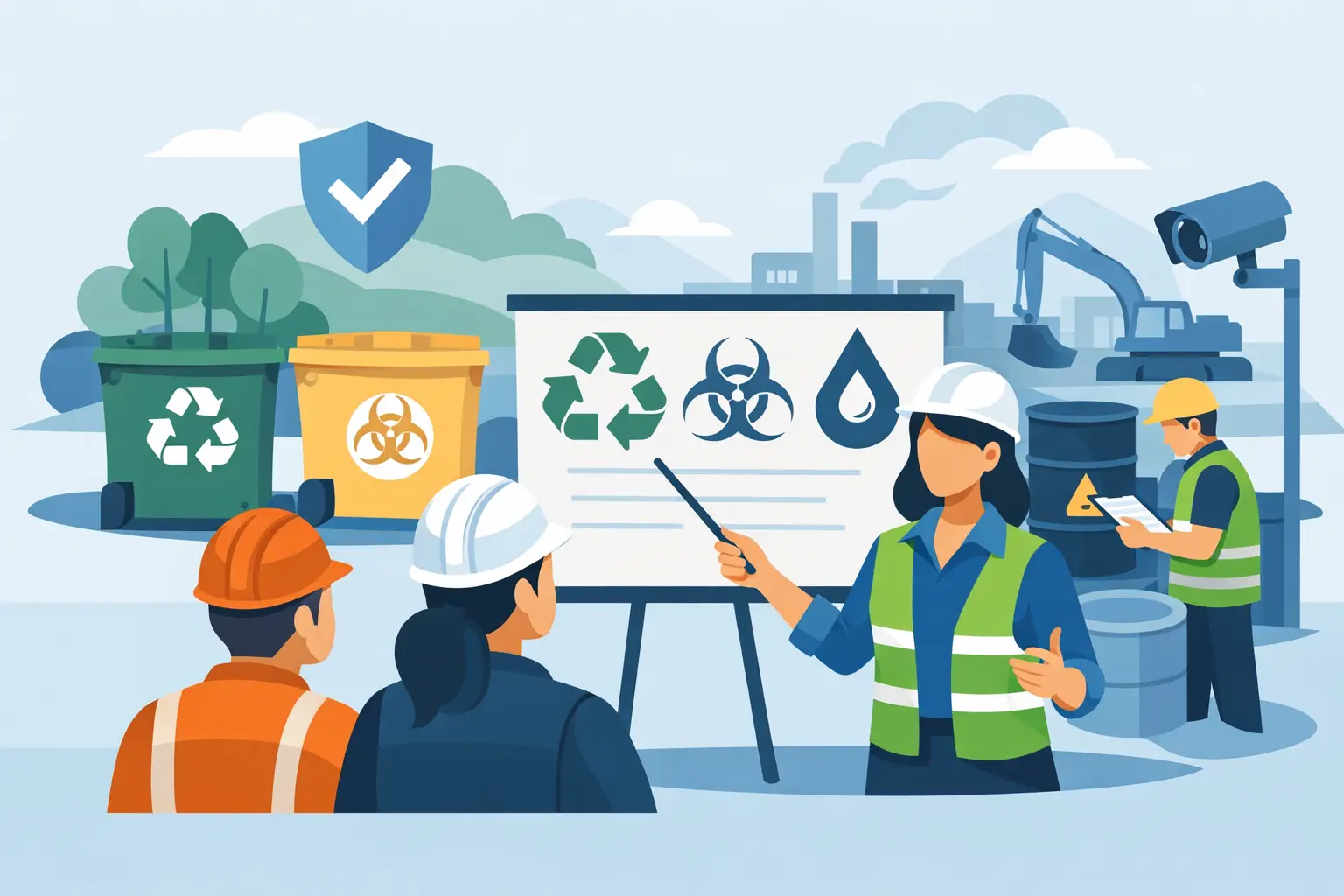
A missed check at the weighbridge, an incorrectly stored load or a poorly understood quarantine procedure can quickly become more than a site issue. Effective waste training gives employees the knowledge to make correct decisions at the point where waste is received, handled, stored and dispatched. For permitted sites, it is a practical control that supports compliance every working day.
Training should not be treated as a one-off induction exercise or a folder of signed attendance sheets. It needs to reflect the activities taking place on site, the conditions of the environmental permit and the real risks faced by operatives, supervisors and managers. When it does, it helps prevent incidents, supports consistent standards and gives operators evidence that competence is being actively managed.
Why waste training matters to permitted operations
Environmental permits place clear responsibilities on operators to manage activities without causing pollution or harm. Permit conditions, management systems, Fire Prevention Plans and operating procedures all depend on people understanding what they are required to do and why. A well-written procedure has limited value if the team responsible for applying it has not been trained in its contents.
Regulators will often look beyond the existence of documentation. They may ask how staff have been briefed, who is competent to accept particular waste streams, what happens when a load does not meet acceptance criteria, and how refresher training is controlled. Inconsistent answers can indicate that site controls are not embedded in daily operations.
There is also a commercial case. Poor waste acceptance, contamination, stockpile mismanagement and inadequate record keeping can lead to rejected loads, additional disposal costs, complaints, enforcement attention and disruption to operations. Training reduces these risks by giving staff defined responsibilities and a clear route for escalating concerns before they become incidents.
Waste training must be relevant to the role
A single presentation for every member of staff is rarely sufficient. The training needs of a site manager are different from those of a plant operative, weighbridge clerk, yard supervisor or transport coordinator. Each person should understand the controls they directly influence, as well as when they must refer an issue to a manager.
For example, personnel involved in waste acceptance need to understand the permit limits, approved waste types, relevant European Waste Catalogue codes, visual inspection requirements and the action to take where documentation or the load itself raises concerns. They should know that accepting a non-conforming load is not simply an administrative error. It can put the operator outside the scope of its permit.
Operational staff require practical instruction on safe and compliant storage, segregation, containment, housekeeping, spill response and reporting. Where combustible waste is handled, training should also reflect the site Fire Prevention Plan, including stockpile limits, separation distances, hot works controls, fire watch arrangements and emergency procedures.
Managers and supervisors need a wider view. They should be able to monitor compliance, identify repeated failures, maintain training records, manage corrective actions and ensure that operational changes are properly communicated. This may include changes to permit conditions, waste acceptance procedures, plant, site layout, contractors or emergency arrangements.
Build training around site controls, not generic slides
Generic awareness sessions can provide useful background, but they should not replace site-specific instruction. The strongest programmes are built from the documents and controls that govern the operation. This creates a direct connection between the permit, management system and the way employees work.
Start by identifying the activities that carry the greatest compliance risk. On a transfer station, this may be waste acceptance and stockpile control. At a treatment facility, it may include process controls, material segregation and the management of residues. A landfill, remediation project or hazardous waste operation will have its own risk profile and competency requirements.
The training content should then explain the required standard in plain operational terms. Rather than telling a team to follow waste acceptance procedures, demonstrate how to check paperwork, inspect a load, identify warning signs and record a rejection. Rather than referring generally to emergency arrangements, walk through who takes control, how an incident is reported and what immediate containment measures are expected.
Short, focused sessions are often more effective than infrequent training days overloaded with information. Toolbox talks, practical demonstrations and supervised observations can reinforce key controls where they matter most: on the yard, at the inspection point, in the office or beside the plant.
What a structured programme should cover
The exact content will depend on the operation and applicable regulatory requirements, but a structured waste training programme commonly addresses these areas:
- permit awareness, including site boundaries, authorised activities, waste limits and operational conditions;
- waste acceptance, classification, documentation checks, inspection and load rejection procedures;
- storage and handling controls, including segregation, containment, drainage protection and housekeeping;
- fire prevention, emergency response, spill management and the reporting of incidents or near misses;
- environmental management procedures, record keeping, complaints, non-conformances and corrective action.
It is sensible to include contractor and agency staff within this approach. They may not need the same depth of training as permanent employees, but they still need a site induction that covers the activities they will undertake, restricted areas, emergency arrangements and the controls they must follow. Operators remain responsible for the standard of activity taking place at their site.
Test competence and keep evidence that stands up to scrutiny
Attendance alone does not demonstrate competence. A signature confirms that someone was present, not that they understood the instruction or can apply it correctly. Training should include a proportionate method of checking understanding, whether through questions, a short assessment, practical observation or supervised task sign-off.
The evidence should be organised and readily available. A clear record will usually identify the employee, role, training topic, date, trainer, method of assessment and any refresher date. Where a person has been trained to undertake a critical task, such as accepting waste, operating plant or responding to a spill, the record should also show how competence was verified.
Training records are particularly valuable following an incident, complaint or regulatory inspection. They allow the operator to show what instruction was given, whether the individual was authorised to perform the task and what actions were taken if gaps were found. This is not about creating paperwork for its own sake. It is about demonstrating that management controls are active and accountable.
Refresh training when the operation changes
Competence can decline when procedures are not used regularly, and training can become outdated when the site changes. Refresher training should therefore be planned rather than left until an issue occurs. The appropriate frequency depends on the risk, staff turnover, task complexity and performance history.
Certain events should trigger an immediate review. These include a permit variation, new waste streams, revised acceptance criteria, a change in site layout, installation of new equipment, a fire or pollution incident, an audit finding, or repeated procedural failures. Following an incident, the aim is not simply to repeat the previous training. The operator should establish whether the procedure was clear, whether the instruction was understood and whether the control itself remains suitable.
New starters also need support after induction. A staged approach, combining initial instruction with supervision and later competency checks, is often more reliable than assuming a first-day briefing is enough. This is especially relevant in busy operations where employees may move between duties or take on additional responsibilities.
Use training to improve, not just to evidence compliance
The best waste training programmes create a two-way conversation between management and the workforce. Operatives often identify practical weaknesses first: unclear signage, awkward inspection areas, recurring paperwork errors, unsuitable containers or procedures that do not match the reality of the site. Capturing this feedback can improve both compliance and efficiency.
EWS Consultancy Services supports operators with structured, site-relevant training that aligns with environmental permits, management systems and fire prevention controls. The focus should always be on practical implementation: giving teams clear instructions, supervisors meaningful oversight and managers defensible evidence of competence.
Training is most effective when it becomes part of normal operational control. Make time to review it after changes, use incidents and near misses as learning opportunities, and ensure that every person understands the standards that protect the site, the business and the environment.