
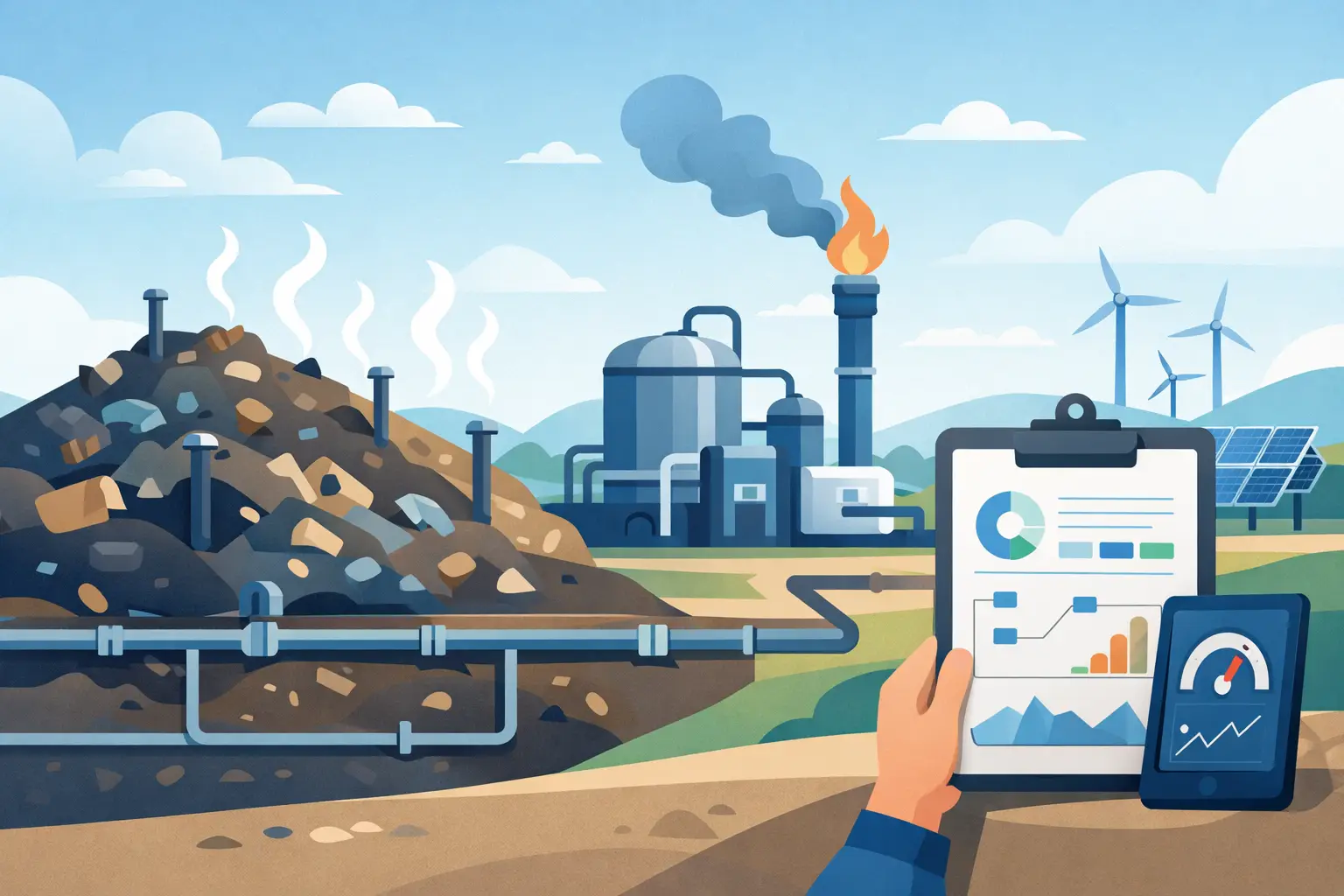
A landfill gas issue rarely begins as a single, obvious failure. It may appear as an elevated perimeter reading, an odour complaint, declining flare performance, gas in a monitoring borehole or an unexpected change following capping works. To create a landfill gas management plan that is useful in practice, operators need more than a generic procedure. They need a site-specific document that connects waste acceptance, engineering controls, monitoring results, maintenance and permit obligations.
For UK landfill operators, the plan should provide a clear basis for controlling methane emissions, reducing off-site migration risk, managing odour and protecting employees, neighbours and the environment. It should also demonstrate to the regulator that the site understands its gas risks and has defined, achievable controls in place.
How to create a landfill gas management plan
Start with the permit, approved operating techniques and all existing supporting documents. A gas management plan must not sit separately from the Environmental Management System, landfill engineering records, monitoring schedule, restoration proposals or emergency procedures. Where requirements conflict or a site has changed since its original permitting documents were produced, this needs resolving before the plan is issued.
The plan should be based on the actual site, not an assumed landfill model. Older cells may have different waste types, lining standards, gas collection infrastructure and restoration arrangements from newer areas. A closed landfill can also remain a significant gas management responsibility for many years, particularly where gas yields are declining and active extraction becomes less effective.
A practical plan normally addresses five connected areas:
- the landfill gas risk assessment and source-pathway-receptor model;
- gas collection, extraction, treatment and utilisation infrastructure;
- monitoring locations, methods, frequencies and trigger levels;
- inspection, maintenance, reporting and corrective-action arrangements; and
- roles, competence, emergency response and document control.
These components should be detailed enough for a site manager or competent operative to act on them without interpretation, while retaining sufficient technical explanation to support permit compliance and regulatory review.
Establish the gas risk profile
The starting point is a current conceptual site model. Identify the likely gas sources, including active deposition areas, capped cells, temporary stockpiles where relevant, leachate systems and any areas of previously deposited waste outside the expected footprint. Consider methane, carbon dioxide, oxygen, nitrogen and trace gases, alongside the potential for odour.
The assessment should then map plausible pathways. These can include migration through landfill lining defects, permeable strata, service trenches, drainage runs, chambers, utility corridors and poorly sealed wellheads. Gas can also escape through the cap, particularly after settlement, drought, heavy rainfall, construction works or damage caused by plant movements.
Receptors will differ by site. They may include site employees, neighbouring property, public rights of way, watercourses, ecological receptors, neighbouring development, enclosed structures and the atmosphere. The assessment should identify the likelihood and consequence of each pathway, but it should also explain the controls that reduce the risk. A risk register with no link to field controls is of limited operational value.
Where monitoring data show a trend, record the trend rather than relying solely on individual results. A single elevated reading may require a prompt inspection. Repeated changes across several wells can indicate a wider issue with extraction balance, cap integrity, leachate levels or seasonal conditions.
Define the gas control system by landfill phase
Gas management changes as a cell progresses from filling to temporary cover, final capping and aftercare. The plan should identify which controls apply at each stage and who is responsible for confirming that they are installed and working.
During filling, temporary gas wells, horizontal collectors, pipework and interim cover may need regular adjustment as waste placement moves. The plan should explain how gas infrastructure is protected from damage, how new connections are commissioned and how inactive lines are isolated. It should also set expectations for daily cover and intermediate cover, as poor cover management can undermine extraction and increase surface emissions.
For capped areas, include the specification and inspection requirements for the cap, gas wells, seals, manifolds and condensate management. Settlement, cracking, ponding and vegetation establishment can all affect performance. Any reinstatement work should be recorded so that future monitoring results can be interpreted properly.
Describe the treatment route in enough detail to make operational limits clear. This may involve enclosed flaring, open flaring where permitted, gas engines, upgrading equipment or a changing combination as gas quality and flow decline. The plan should state how the site responds to flare downtime, engine trips, poor methane quality, condensate blockages, loss of suction and power failure. It should not assume that installed equipment is always available.
Set monitoring that drives decisions
Monitoring is not simply a reporting exercise. The schedule should explain what is measured, where, how often, using which equipment and what action follows an adverse result. It should cover landfill gas wells, perimeter boreholes, surface emissions surveys, extraction compound checks and, where applicable, buildings, service routes and leachate infrastructure.
Fixed trigger values should only be used where they are supported by the permit, approved procedures, relevant guidance or a defensible site-specific assessment. Copying limits from another landfill can create false assurance. Instead, set clear site action levels and escalation routes, distinguishing between a result that requires routine adjustment, a result requiring urgent investigation and an event that may require regulator notification.
For each monitoring point, retain information on location, construction, condition, accessibility and historical behaviour. Readings should be recorded with relevant operating context, such as weather, atmospheric pressure, extraction settings, recent capping works, plant downtime and waste placement. Without this context, trend analysis becomes less reliable.
Equipment control matters as much as the monitoring schedule. Portable gas analysers require calibration, pre-use checks and competent users. Field staff should understand the limitations of readings in wet wells, restricted spaces and low-flow conditions. Confined-space risks must be assessed separately and managed through suitable safe systems of work.
Build workable response and maintenance procedures
A management plan should make abnormal conditions straightforward to manage. For example, if perimeter gas concentrations rise, the immediate actions may include confirming the reading, checking nearby gas wells and pipework, reviewing extraction balance, inspecting potential migration routes and increasing monitoring frequency. The appropriate response will depend on the location, concentration, trend and receptor sensitivity.
The document should also identify who can alter extraction settings, who authorises repairs and when specialist support is required. Uncontrolled adjustment of valves can move a problem from one part of the landfill to another. Excessive suction may draw air into the system and increase fire risk, while insufficient extraction can allow emissions and migration. Gas field balancing therefore needs competent oversight and a record of each significant change.
Preventive maintenance should cover wellhead integrity, valve operation, pipework supports, condensate traps, blowers, flares, engines, telemetry and standby arrangements. Defects should be logged, prioritised and closed out with evidence. Where repairs are delayed, the plan should specify interim controls and review dates.
Emergency arrangements should be proportionate to credible scenarios, including fire, explosion risk, gas migration into a structure, major plant failure, damage to gas pipework and significant odour emissions. They should align with the site emergency plan and include contact arrangements, evacuation considerations, isolation procedures, communications and post-incident investigation.
Keep the plan live and auditable
A landfill gas management plan becomes ineffective when it is treated as a one-off permitting attachment. It should be reviewed following changes to waste inputs, cell construction, gas infrastructure, monitoring trends, complaints, incidents, permit variation, restoration works or changes in neighbouring land use. A scheduled review is also sensible even where no obvious change has occurred.
Assign named responsibilities for daily checks, monitoring, data review, maintenance coordination, regulatory reporting and management oversight. Training should reflect those responsibilities. An operative taking wellhead readings needs different competence from a manager reviewing extraction trends or a contractor maintaining flare equipment.
Controlled records are essential. Keep monitoring sheets, calibration certificates, maintenance records, investigation reports, photographs, training evidence and version-controlled plan updates together. This supports continuity when personnel change and provides evidence that identified risks have been actively managed.
The most effective plans are written around the decisions a site team must make under pressure. If the document tells people what to inspect, when to escalate and how to record the outcome, it becomes a practical control rather than another folder on the shelf.